The Sports Science Technology Landscape Has Changed Dramatically
A decade ago, the sports science technology toolkit at most elite clubs consisted of a GPS tracking system, perhaps a heart rate monitoring platform, a physiotherapy management database, and a collection of spreadsheets attempting (likely failing) to connect them all. Today, the landscape has exploded: there are now hundreds of specialized software platforms for load monitoring, wellness tracking, video analysis, nutrition management, strength and conditioning, medical records, GPS analytics, and performance psychology. Each claiming to be essential, each requiring its own login, and none of them talking to each other by default. The technology stack challenge in modern elite sport (and also in recreational sport for that matter) is not a shortage of tools. It is a glut of disconnected systems that collectively demand more staff time to operate than they save, produce data that lives in silos rather than integrated views, and generate alert fatigue rather than genuine insight. This guide helps performance directors think clearly about what a well-designed sports science stack looks like, what core components it must include, and how to evaluate platforms against the integration problem.
Core Components of an Effective Sports Science Stack
1. Training Load Monitoring
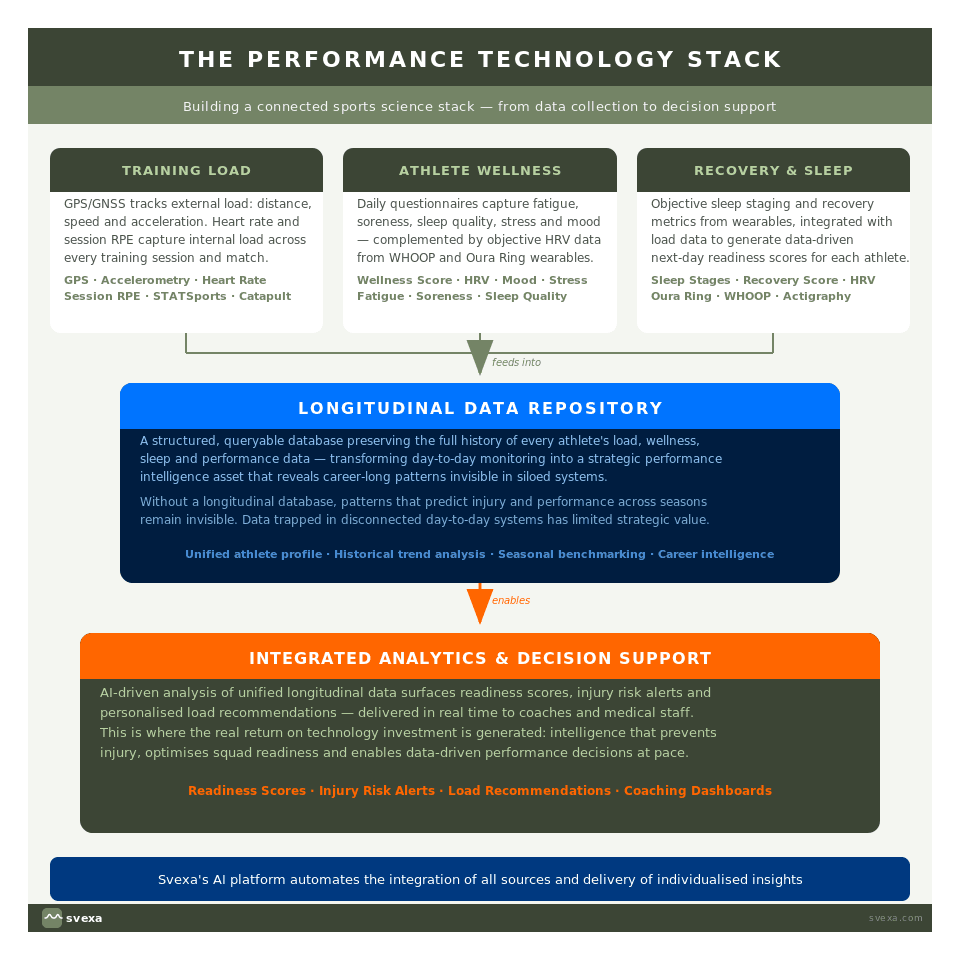
The foundation of any sports science tech stack is a system for capturing and quantifying training load – both external (GPS/GNSS for distance, speed, acceleration metrics) and internal (heart rate, session RPE). GPS systems from providers such as STATSports, Catapult, and Statscore are widely deployed; the key evaluation criteria are GPS sampling frequency, accuracy in indoor environments, data export flexibility, and integration capability with your analytics platform. Svexa actually uses proprietary algorithms to generate an integrated load metric that we use to underpin our recommendation tools like Irma.
2. Athlete Wellness Monitoring
Daily wellness questionnaires – capturing subjective fatigue, muscle soreness, sleep quality, stress, and mood – remain among the most cost-effective performance monitoring tools available. When combined with objective data (HRV from wearables such as Oura, Garmin watch etc), daily wellness data provides the subjective complement to objective load metrics. Integration is critical: wellness data that sits in a separate system from load data has limited analytical value. Svexa has a free app Readiness Advisor that captures this vital subjective data daily, and can be integrated with our wider products.
3. Recovery and Sleep Monitoring
Sleep quality and recovery status are now understood to be among the most important determinants of next-day training readiness and injury risk. Consumer-grade wearables (Oura Ring, WHOOP) and research-grade actigraphy provide objective sleep data that, when integrated with load metrics, enables genuinely data-driven readiness scoring. This is only valuable, however, when the data flows into a central system that contextualizes it against training load and wellness trends.
4. Longitudinal Data Repository
Without a structured longitudinal database, all monitoring data has only immediate tactical value – it can inform today’s training decision but cannot reveal career-long patterns, seasonal trends, or the multi-year predictors of injury and performance that represent the true potential of athlete data. A purpose-built longitudinal platform that preserves historical data in structured, queryable form transforms monitoring from a day-to-day function into a strategic performance intelligence asset. This is what svexa’s Digital Twin delivers – we connect to available data sources for each athlete and maintain an up-to-date physiological profile.
5. Integrated Analytics and Decision Support
The system that integrates data across all of the above, and transforms it into actionable insights for coaches and medical staff, is the most strategically important component of the stack. An integrated platform that ingests GPS, wellness, sleep, and load data and surfaces readiness scores, injury risk alerts, and load recommendations is where the real return on technology investment is generated. This is the layer where AI adds genuine value, and it’s exactly what svexa does.
The Integration Problem: Why Most Stacks Underperform
The core failure mode of most sports science technology stacks is integration failure. A club may have excellent GPS hardware, a solid wellness platform, a well-adopted HRV monitoring program, and a sophisticated video analysis system. But if the data from each lives in a separate system and can only be reviewed in parallel rather than integrated, the analytical power of the whole is far less than the sum of its parts. Staff spend 40–60% of their time manually collating data from different platforms. Patterns that would be obvious in an integrated view are invisible. Alert fatigue sets in as notifications from multiple disconnected systems compete for attention. Platforms designed from the ground up for integration – with open APIs, flexible data ingestion, and a single athlete profile that aggregates all data sources – represent a fundamentally different approach. Svexa’s platform was built on exactly this principle: a modular, API-first infrastructure that integrates data from any source into a unified athlete profile and delivers integrated insights.
Contact Us any time to learn more about svexa’s integrated approach.
Evaluating Platforms: Questions to Ask
- Does it integrate with our existing GPS hardware and wellness tools, or does it require a platform switch?
- Does it provide individualized baselines, or does it apply population-average thresholds?
- Is the analytics methodology peer-reviewed and scientifically validated, or proprietary and opaque?
- What does the data ownership and portability policy look like if we switch vendors in three years?
- How does it scale – from first team to Academy, from 25 players to 150?