

the science of the individual
Svexa builds a unique physiological Digital Twin of every person, then our human performance AI uses each new workout, night’s sleep and race result to predict performance and decide what training should come next. Our algorithms come from two decades of research at Karolinska Institute and Stanford University, and they have been tested on everyone from Olympic champions to sedentary workers.
40%
fewer days lost to injury on average
in elite football and NFL teams
in elite football and NFL teams
3.8%
mean error in
predicted 10 km race times
predicted 10 km race times
57%
larger 3000m improvement with
adaptive vs static plans (ELLIDA trial)
adaptive vs static plans (ELLIDA trial)
14-89
age range of participants
in our validation cohorts
in our validation cohorts
the core idea small data beats big data
Population-scale “big data” is excellent for spotting trends and giving a new user a sensible starting point. But it hits an accuracy ceiling as soon as you ask what will work for *this* unique person. Their own “small data” is much more powerful, as two people with near-identical wearable data can respond very differently to the same training.
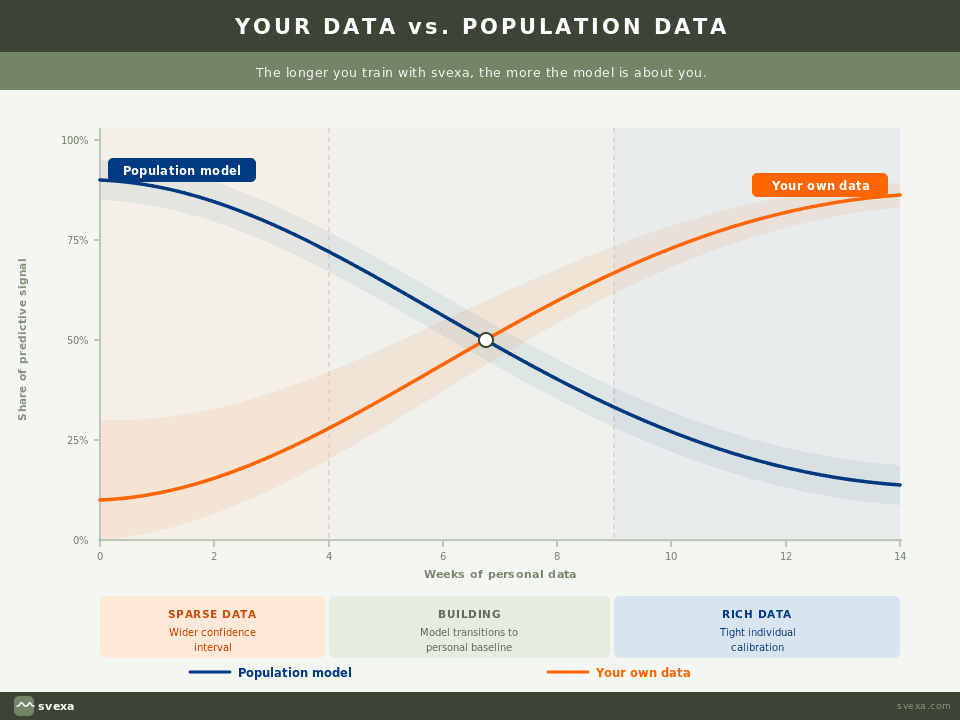
Svexa’s approach is built in two layers:
- Population foundation. For a brand-new user, models grounded in exercise physiology and population data give safe, useful recommendations from day one.
- Individual calibration. As a clean, continuous record of that person’s own responses builds up, their personal history becomes the dominant source of predictive signal. The model shifts weight from the crowd to the individual.
This is why we don’t quote one global accuracy number. Accuracy scales with how much good data we have for each person, and our models widen their confidence intervals when data is sparse rather than over-claiming precision.
How we validate
Accuracy mapped to data, not a single headline.
Our analytics work in a hierarchy, depending on level of available data.
- Physiological foundation: relies on validated exercise-physiology principles to deliver safe baselines, even for new users
- Sparse data / low engagement: relies on physiology, heuristics, user-reported milestones to deliver useful guidance with deliberately wider confidence intervals
- Rich data / medium–high engagement: Relies on frequent wearable data, HR kinetics, training load to deliver markedly tighter race-time and training predictions
Rather than a one-off trial on a fixed population, our validation evaluates accuracy across data-density tiers and user engagement profiles, because that is how the technology behaves in the real world.
explore the science

How it works: The Digital Twin
How svexa turns messy wearable data into a continuously updated model of each person.

Research & data foundation
Six prospective cohorts, ages 14–89, sedentary to Olympic, plus millions of real-world observations

Performance prediction
Race-time forecasts that improve with every result: 5.7% error on a first race, 3.5% after one result.

Adaptive training
Plans that re-plan daily, tested in a controlled clinical trial

Expert coaching philosophies
“Seidurs”: AI plans that world-class coaches judged indistinguishable from their own.

Injury risk & load
Zone7 by svexa: daily injury-risk forecasting for professional teams

Proof of accuracy
Head-to-head benchmarks against commercial wearables and GPS load metrics.
Read More

Scientists & publications
The founders, the research heritage, and our peer-reviewed papers.
Read More
Put individualized intelligence inside your product
Svexa licenses its algorithms through the svexa API to wearable makers, training platforms, sports teams and health providers. Talk to our science team about validating svexa on your own devices and users.
FAQ
- What is a digital twin in sport and health?
A digital twin is a continuously updated model of one individual’s physiology. Svexa’s digital twins combine training history, wearable data, test results and context such as sleep, illness and schedule to predict how that person will perform and respond to training. - How accurate are svexa’s predictions?
Accuracy depends on how much data we have for each person. In real-world validation, first-race predictions for recreational runners averaged 5.7% error, falling to 3.5% after one prior race; 10 km race predictions averaged 3.8% error. - Does svexa need a lot of data before it works?
No. New users start from physiology-based population models and get useful guidance immediately; personalization increases as their own data accumulates. - Is svexa’s research peer-reviewed?
Yes. The svexa team has published in journals including Cell Metabolism, Sports Medicine Open, Nature Communications and The Lancet Digital Health. See our publications page.
newsletter signup
Once in a while we send our subscribers a newsletter with corporate news, useful industry information or just a sneak peek of what we’re doing at svexa.