More Than an Algorithm
The term “AI coaching” has been diluted by overuse. Every app that auto-generates a training plan from questionnaire answers now markets itself as AI-powered. But there is a significant difference between a rule-based system that applies a generic template to your stated goal and a true machine learning system that builds and continuously updates a physiological model specific to you. Understanding what separates genuine AI coaching from sophisticated marketing requires a brief journey into the science – and it starts with data.
The Data Foundation: What AI Actually Needs to Work
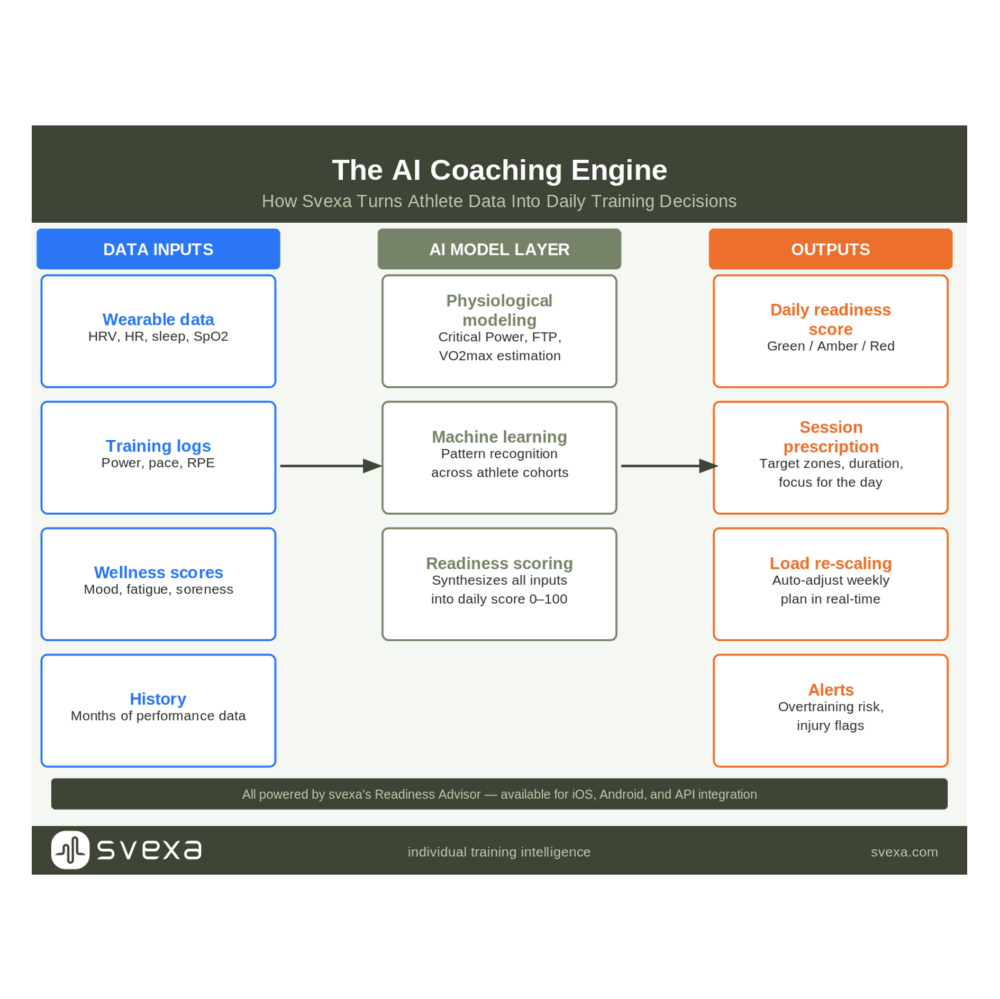
AI coaching systems are only as good as the data that feeds them, and the domain expertise guiding the training and setting the guard rails (if any). Svexa’s AI can work with a minimum viable dataset that could be as simple as daily subjective wellness data (sleep quality, fatigue, mood, soreness) captured through our free Readiness Advisor app. For deeper personalization we’d ideally also include training history (volume, intensity, and structure over time), physiological response data (HRV, heart rate, lactate or proxy measures), and performance data (power, pace, or any repeatable objective measure of fitness output). We typically capture these automatically through connection to wearable devices. With only one or two of these data streams, an AI system is working with incomplete information. A training plan that adjusts based solely on workout completion cannot tell the difference between an athlete who is well-rested and highly adapted versus one who is deeply fatigued but pushing through on willpower. The power of multi-modal data integration is that it makes these distinctions visible.
The Modeling Layer: How AI Learns Your Physiology
Modern AI coaching platforms use several categories of machine learning and physiological modeling in combination:
- Individual physiological modeling: Rather than applying population-average training zone prescriptions, the system learns each athlete’s characteristic response patterns, their typical HRV range at different training loads, their recovery kinetics after hard efforts, their performance trajectory across a training block. Svexa captures all of this in our Digital Twin, that underpins our recommendations.
- Predictive load modeling: Old-style systems built on the Acute:Chronic Workload Ratio (ACWR) or Banister’s Impulse-Response model did not have the same data opportunities as today, and use mathematical models to predict how current training load will affect future fitness and fatigue. AI extends this by personalizing the model parameters rather than using fixed values.
- Anomaly detection: Machine learning excels at identifying deviations from an individual athlete’s normal patterns. A resting HR that is 8 bpm above baseline is flagged not because it exceeds a generic population threshold but because it deviates from that specific athlete’s established baseline – a far more sensitive and specific signal.
Recommendation engines: Drawing on all of the above, an AI recommendation system like svexa’s Irma generates training prescriptions that are optimized for the individual’s current state, historical response patterns, and stated goals – updated daily as new data arrives.
What AI Coaching Can and Cannot Do
Genuine AI coaching can deliver measurable advantages over static or generic plans: more precise load management, better-timed recovery, more appropriate intensity targeting, and early warning of overreaching. Research by Mujika and Padilla published in Medicine & Science in Sports & Exercise showed that individualized training prescription produces superior performance outcomes compared to standardized approaches, even when total training volume is identical. But AI coaching has limits that honest practitioners acknowledge:
- Data quality: The system is only as good as the data it receives. Inconsistent wearable use, missed wellness check-ins, or inaccurate self-reporting all degrade model accuracy.
- Edge cases: A personal trainer or a close coach can detect and adjust to anomalies, disruptions, and nuances that might be unknown to the AI Coach.
- Motivation and psychology: The most sophisticated physiological model cannot replace a coach’s understanding of an athlete’s psychology, race-day mindset, or competitive instincts. The best AI coaching platforms acknowledge this and use AI for load management and physiological optimization while leaving the human elements to the athlete’s own judgment or a human advisor.
The Svexa Approach to AI-Driven Individual Coaching
Svexa’s individual performance platform applies the same AI-powered athlete modeling that has been deployed across professional sports teams to the individual endurance athlete. The same physiological modeling that helps elite football clubs manage squad availability is adapted to help individual cyclists, runners, and triathletes optimize their training response.
Digital Twin integrates data from any wearable or training device into a unified athlete profile. Irma synthesizes this data into daily actionable guidance. The Overtraining Detection module flags accumulated fatigue before it becomes performance-limiting. And of course, all of svexa’s algorithms and products combine raw AI horsepower with the latest science and decades of real world athletic and coaching experience, to deliver results beyond simple data analysis. To understand the science behind the approach, explore svexa’s case studies or Contact Us any time to discuss in more detail.