Availability Is the Competitive Advantage No One Talks About Enough
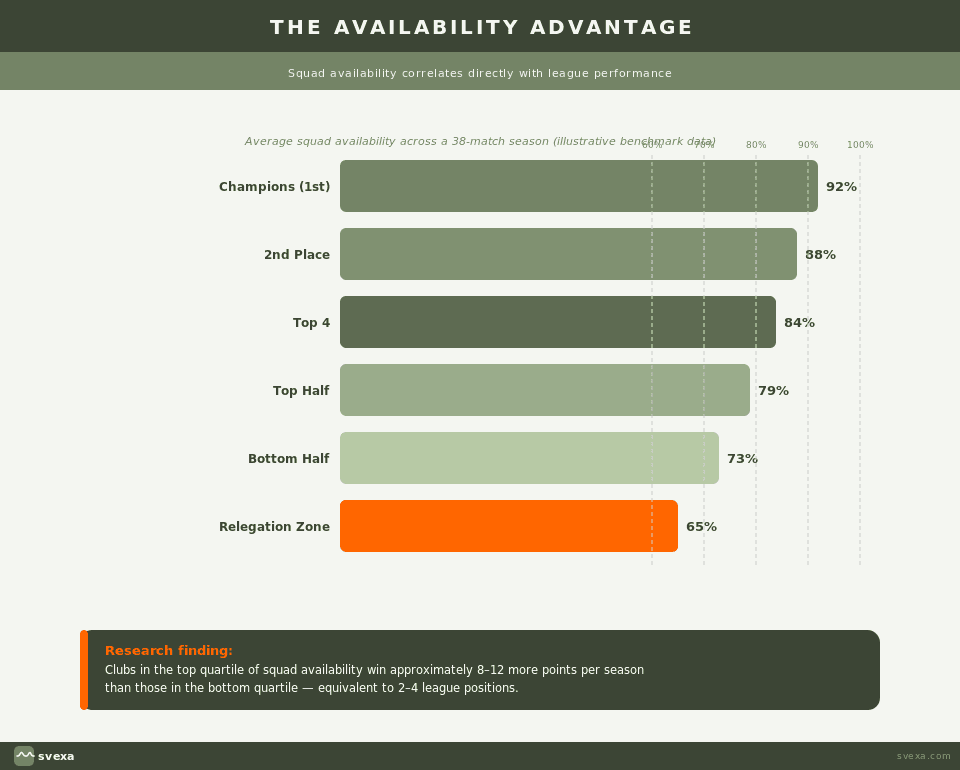
In elite team sports, no performance metric correlates more strongly with competitive success than squad availability. Study after study, and any experienced performance director without hesitation, will tell you the same thing: the teams that win are the teams whose best players are on the pitch. Injury absence doesn’t just reduce talent on paper; it disrupts team cohesion, forces tactical compromise, strains squad depth, and drains the morale of healthy players managing elevated minutes. A study of nine seasons of Premier League data found that clubs with the highest squad availability rates, measured as percentage of the squad available for selection each match, significantly outperformed injury-blighted rivals in both league position and Champions League qualification. The data is unambiguous: keeping players healthy is not a supporting function of high performance, it is one of its primary drivers.
The Science of Injury Prediction
Predicting sports injuries before they occur is genuinely difficult. Unlike mechanical systems, human physiology does not fail in predictable ways – the interaction of training load, fatigue, sleep quality, previous injury history, biomechanical risk factors, psychological stress, and nutritional status creates a complex, dynamic risk landscape that shifts daily for every athlete. Traditional injury prevention approaches addressed individual components of this landscape in isolation: pre-season screening for biomechanical risk factors, GPS monitoring for load spikes, blood testing for nutritional deficiencies. Each approach captures something real, but none captures the full risk picture. A player who is biomechanically “clean,” has moderate GPS loads, and has optimal iron levels can still be at high injury risk if they have been sleeping poorly, are under personal stress, and are returning from a period of reduced training. Machine learning changes this equation fundamentally. AI models can simultaneously process dozens of variables, not sequentially, but in integrated combination, and identify risk patterns that emerge only at the intersection of multiple adverse factors. This is why AI-based injury prediction systems like Zone7 by svexa consistently outperform single-metric approaches and clinician intuition alone in peer-reviewed validation studies.
How Zone7’s AI Works
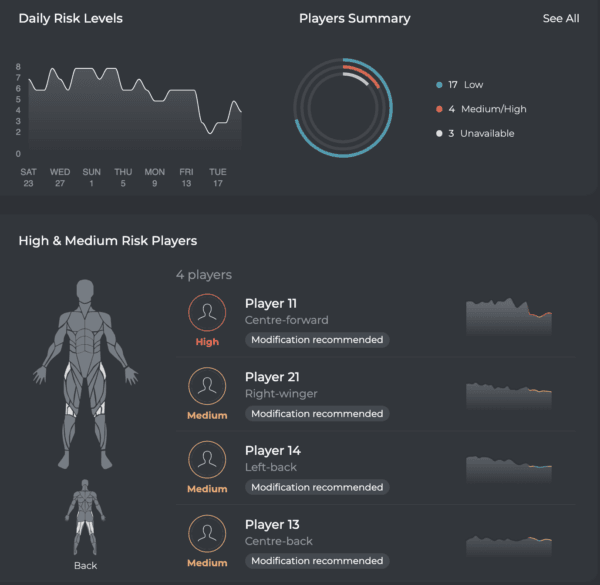
Zone7 is svexa’s AI-powered injury risk and load planning platform, specifically designed for elite team sports. The system ingests daily data from GPS tracking, heart rate monitoring, sleep wearables, wellness questionnaires, historical injury records, and training session logs to build individualized physiological models for each athlete. Svexa captures all of this in our Digital Twin, that underpins our recommendations. These models learn each player’s characteristic response patterns – their normal HRV range when well-rested, their typical load response at different points in the season, their historical injury vulnerabilities. It uses these individualized baselines to detect anomalies that signal accumulating risk. Each morning, Zone7 produces a risk score and load planning recommendation for every athlete in the squad. Coaching and medical staff see a clean, color-coded dashboard: green athletes are well-prepared for high-intensity work; amber athletes need load modification; red athletes require intervention. The system also flags the specific factors driving each risk score, enabling targeted responses rather than blanket load reductions.
In addition to the daily risk dashboard, Zone7 allows coaches or performance staff to address high risk players by simulating load for the upcoming week based on the team’s training or match session plans. They can adjust individual parameters (e.g. total distance covered or number of accelerations), or swap in different sessions from their standard list. In this way, they can reduce the predicted risk for key players.
Explore Zone7’s capabilities and service tiers at zone7.ai, and read about how Zone7’s approach to injury prevention has been recognized by sports media.
The Business Case for Prioritizing Availability
The financial case for investing in AI-powered injury prevention is compelling. Consider the fully-loaded cost of a single top-line player out for eight weeks: salary continuation, replacement player costs (loan fees or increased usage of alternatives), physiotherapy and medical costs, performance value of goals or clean sheets not delivered, and potential knock-on effects on squad morale and results. In Premier League terms, this figure routinely exceeds £2–4 million per significant injury episode. Zone7 case studies based on client data consistently shows availability improvements of 15–25% following platform implementation, driven by earlier identification of risk accumulation and more targeted load management. The ROI calculation is straightforward: for a club with a £40 million wage bill and a historical injury rate consuming 15% of available player-seasons, a 20% reduction in soft-tissue injuries represents a return many times the cost of the platform.
Implementation: From Dashboard to Decision
The most sophisticated injury prediction model in the world delivers zero value if its outputs are not translated into concrete training decisions. Successful implementation of Zone7 or any AI injury prevention platform requires:
- Clear ownership: who receives the daily risk reports, and who has authority to modify training accordingly?
- Workflow integration: risk scores must reach coaches before training, not after
- Cultural buy-in: coaches who understand the science behind the system trust it more and act on its recommendations consistently
- Data quality investment: AI is only as good as its inputs – GPS data, wellness reporting, and sleep monitoring must be consistently collected
Contact Us any time to learn more about how Zone7 manages roster risk and optimizes performance for teams in any sport. Or how svexa’s broader IRMA performance platform and Athlete Passport can provide a complete picture of long-term athlete health and training recommendations.