

Performance prediction that get sharper with every activity
Svexa predicts what an individual can achieve on race or event day from their everyday training data, and updates that prediction continuously as fitness rises, plateaus or falls
5.7%
mean error predicting a runner’s first
3000 m race, with no prior result
3000 m race, with no prior result
3.5%
mean error once one
race result is available
race result is available
3.8%
mean error predicting
10k finish times (R² = 0.81)
10k finish times (R² = 0.81)
0.3%
mean error for elite swimmers
ahead of World Championships
ahead of World Championships
what svexa predicts
Svexa can generate performance predictions for almost any race distance or event duration where there’s enough training and performance data. Accuracy is highest for predominantly aerobic events, from about **3 minutes to several hours**, where training load, physiological capacity and recent performance carry the strongest signal.
- Short- and long-horizon predictions, continuously updated.
- Predicted time or performance, with a confidence estimate where appropriate.
- Immediate individualized predictions for users with rich history; population-informed predictions for new users until their own data takes over.
How it works
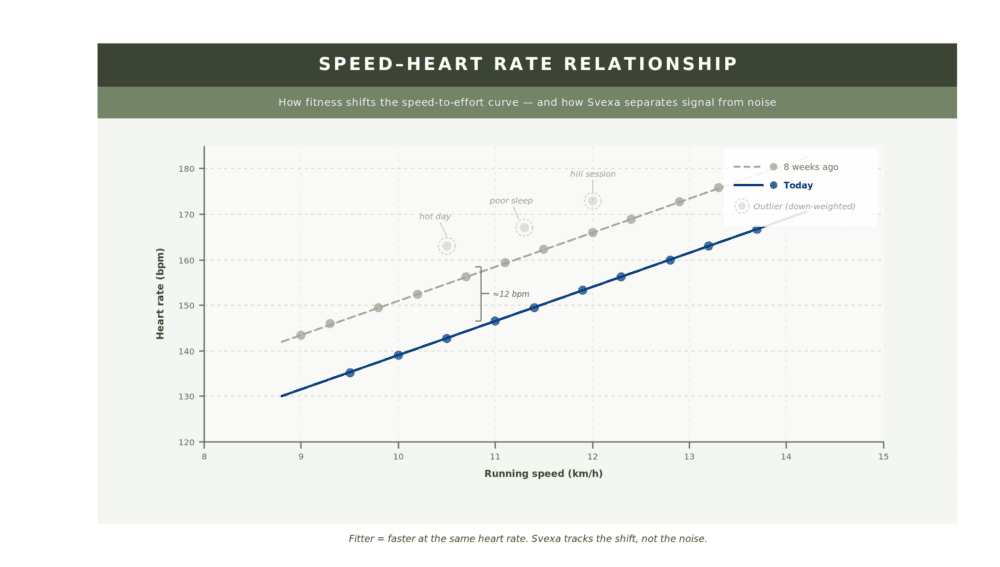
The foundation is the individual relationship between speed (or power) and physiological effort, with heart rate as the key measure of internal load.
Raw data first passes through svexa’s proprietary filtering and quality-control framework. The speed–heart-rate relationship is then interpreted in context, because a given heart rate doesn’t mean the same thing on every day. Factors accounted for include:
- exercise duration and heart-rate drift
- gradient and elevation profile
- running surface
- weather and environmental conditions
- time of day
- recent training and session characteristics
Combining these corrected observations across many sessions, svexa estimates the person’s underlying performance state and how it is changing. The result responds to genuine improvement or decline while staying largely immune to a single bad session or a hot, hilly day.
how we test it
Svexa’s predictions are validated prospectively, with repeated standardized testing, not just compared retrospectively with old race results.
- Ellida #1 (N = 38) and Ellida #2 (N = 18): recreational runners tested in the lab and field before, during and after the training period, with VO₂max, lactate threshold, running economy and standardized race performance as reference outcomes.
- Blue Collar (N = 45): the same pre/mid/post design in a lower-fitness population, focused on VO₂max, blood pressure and blood glucose.
Results: as messy as real life gets
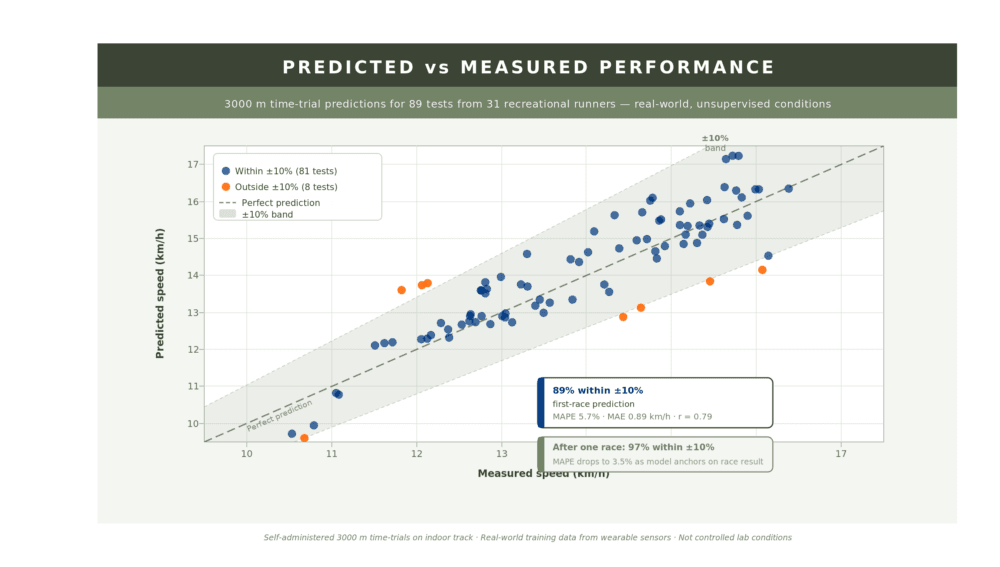
In one validation cohort, 31 recreational runners followed individualized svexa plans at home, unsupervised, and ran their own 3000 m time trials on an indoor track. Predictions were generated from their real-world training and wearable data: no lab baseline, self-administered races, real-world pacing and conditions. 89 time trials in total.
- Mean absolute percentage error: first prediction 5.7%, after one race 3.5%
- Mean absolute error: 0.89 km/h (≈ 39 s over 3000 m)
- Mean bias: +0.12 km/h (+0.9%)
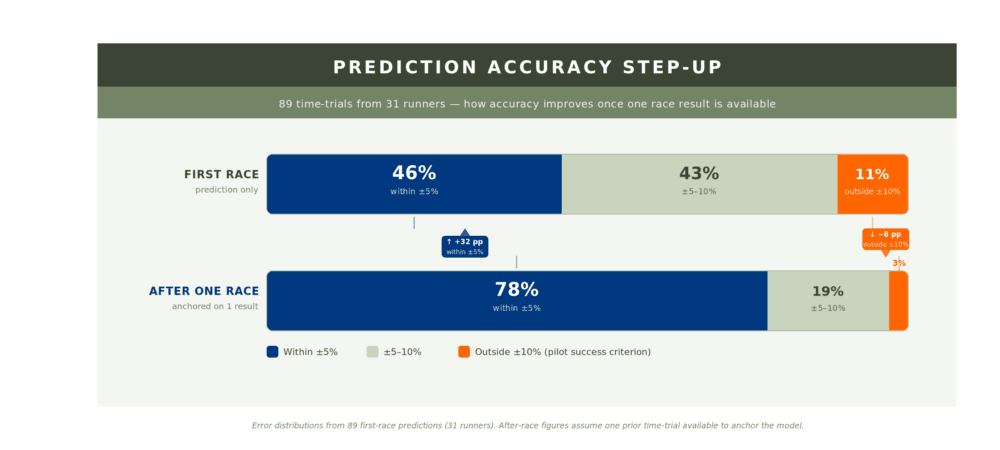
- Within ±5%: first prediction 46% of tests, after one race 78% of tests
- Within ±7%: 67% of tests
- Within ±10%: first prediction 89% of tests, after one race 97% of tests
- Correlation (predicted vs measured): r = 0.79
Why does one race help so much? About 89% of prediction error came from a stable, person-specific offset rather than random noise. Once the model sees one actual result, it corrects that offset, and accuracy jumps. That’s the svexa principle in action: the more the model knows about you, the better it gets.
Across ability levels: 10 km results
In a prospective pilot with race-registration platform RaceID, twelve runners from around 35 to over 60 minutes for 10 km followed adaptive Ellida plans for eight weeks. Predicted race times matched actual results within 3.8% (about 100 seconds), predicted race heart rate within 2.8 bpm, with R² = 0.81 across the full ability range. Read more on the RaceID Case Study page
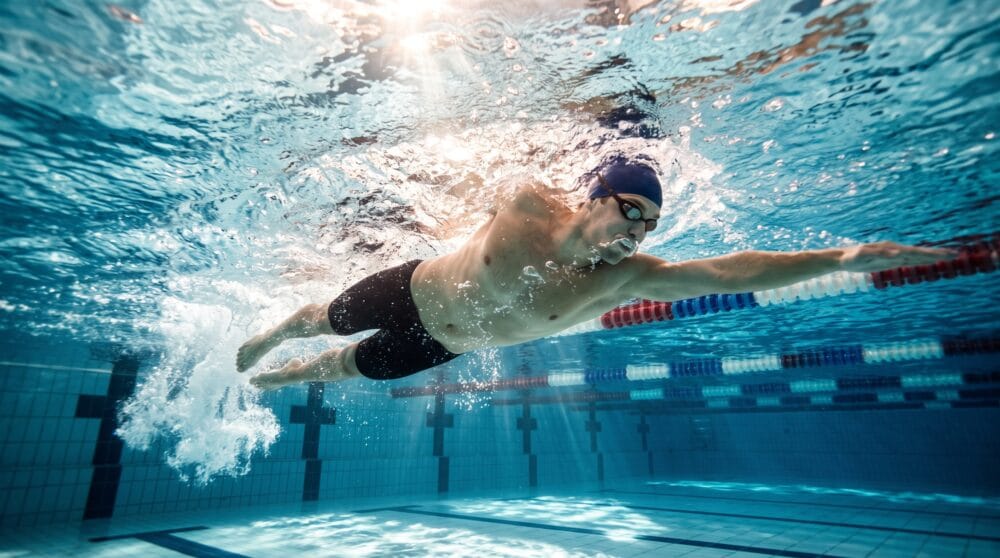
Elite swimming
Working with elite swimmers ahead of the 2019 FINA World Championships, svexa’s race-time predictions had a mean error of 0.3% (0.35 seconds). Every athlete svexa worked with under this approach set a new personal best.
See the evidence for each of these on our Proof of accuracy page.
FAQ
- How accurate is svexa’s race time prediction?
In unsupervised, real-world conditions, 5.7% mean error for a runner’s first race, improving to 3.5% after one race result. Across 10 km runners of all levels, 3.8%. For elite swimmers, 0.3%. - What distances can svexa predict?
Almost any distance with enough data, and it’s most accurate for aerobic events lasting roughly 3 minutes to several hours, from 1500 m to the marathon and beyond. - How is this different from a race time calculator?
Calculators extrapolate from one recent result using a population formula. Svexa models your individual speed–heart-rate relationship across all your training, corrects for conditions, and updates as you get fitter. - Do I need a recent race for a prediction?
No. Svexa predicts from training data alone; a race result simply sharpens the prediction
Continue exploring svexa science
- Adaptive training
- Proof of accuracy
- Research & data foundation
newsletter signup
Once in a while we send our subscribers a newsletter with corporate news, useful industry information or just a sneak peek of what we’re doing at svexa.