

Training plans that adapt to real life
Real training never goes to plan. Sessions get missed, fatigue builds, colds happen, work gets busy, and fitness improves faster or slower than expected. Svexa doesn’t try to force you back onto a fixed schedule. It reassesses where you are today and recalculates the best path to your goal, delivering truly adaptive training.
57%
larger 3000m improvement with
adaptive vs static plans (ELLIDA trial)
adaptive vs static plans (ELLIDA trial)
Daily
plan re-evaluation,
not fixed multi-week blocks
not fixed multi-week blocks
10 of 12
runners finished within a minute
of target or better (RaceID pilot)
of target or better (RaceID pilot)
100%
of elite swimmers in svexa’s 2019
program set personal bests
program set personal bests
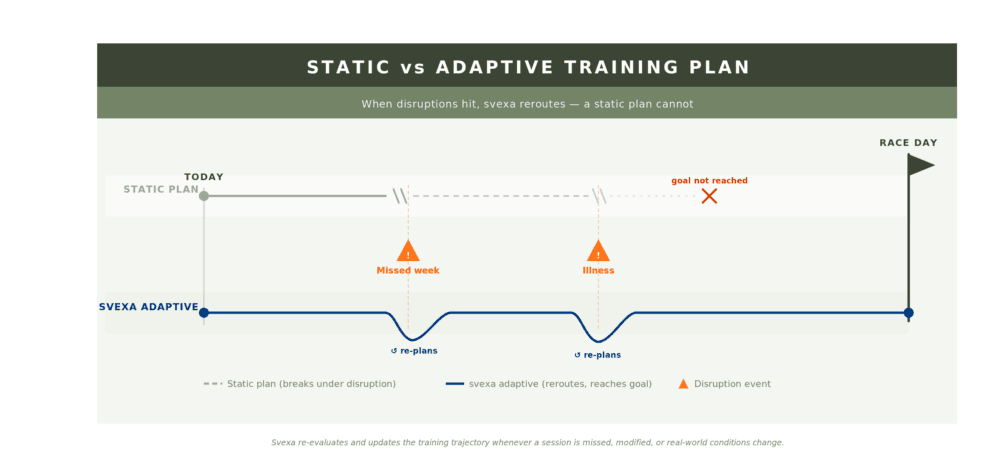
“Plan and hope” versus continuous optimization
Most consumer training-plan generators produce a fixed multi-week schedule at the start and allow only minor manual tweaks. Svexa’s goal is different: not simply to generate a plan, but to continuously select the training stimulus most likely to move each person toward their goal, based on how they are actually responding.
Performance prediction is the feedback signal. If fitness develops as expected, the strategy holds or progresses. If improvement is slower or faster than predicted, svexa changes what comes next: total load, intensity, volume or training composition.

What every recommendation considers
Each recommendation is weighed against the longer-term trajectory, not optimized as a single workout in isolation:
- target goal and competition dates
- current fitness and predicted performance
- recent training load and intensity distribution
- recovery and readiness (wearable and self-reported)
- previous responses to training
- available training time and schedule changes
- injury or illness status
- what was actually completed versus planned
How these are integrated and weighted is proprietary svexa technology.
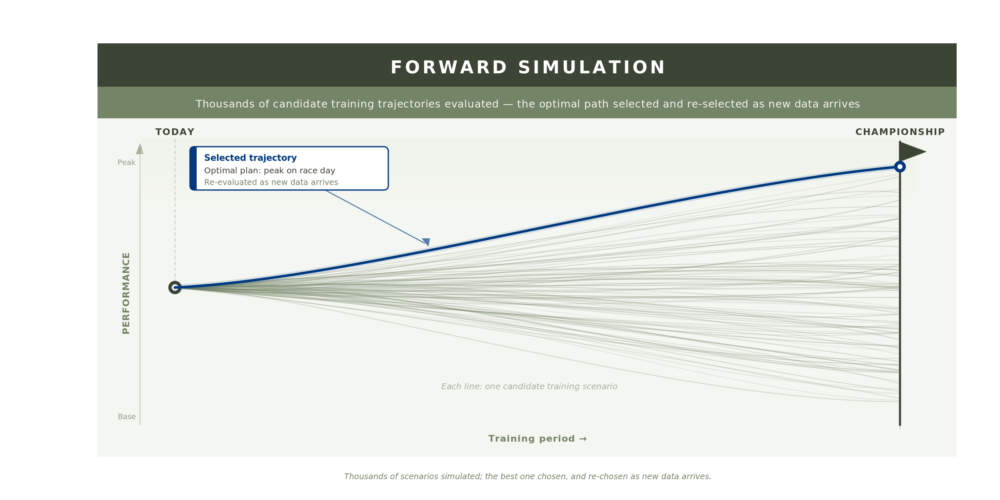
Re-planning every day
Svexa reassesses the plan whenever circumstances change: a missed or modified session, a lack of improvement, new availability, accumulating fatigue, injury, illness or a new goal. Ellida, svexa’s endurance training planner, typically triggers an updated plan every day based on user activity.
In elite environments the same engine goes further. Ahead of the 2019 FINA World Championships, svexa ran continuous forward simulations of thousands of candidate training-load scenarios, re-evaluated as new data arrived, to choose the trajectory most likely to peak each swimmer on race day. Every athlete svexa worked with under this approach set new personal bests, with the first cohort improving by an average of 1.0 second (about 1%) over 200 m.
EVIDENCE #1: Applied pilot: RaceID, 2021
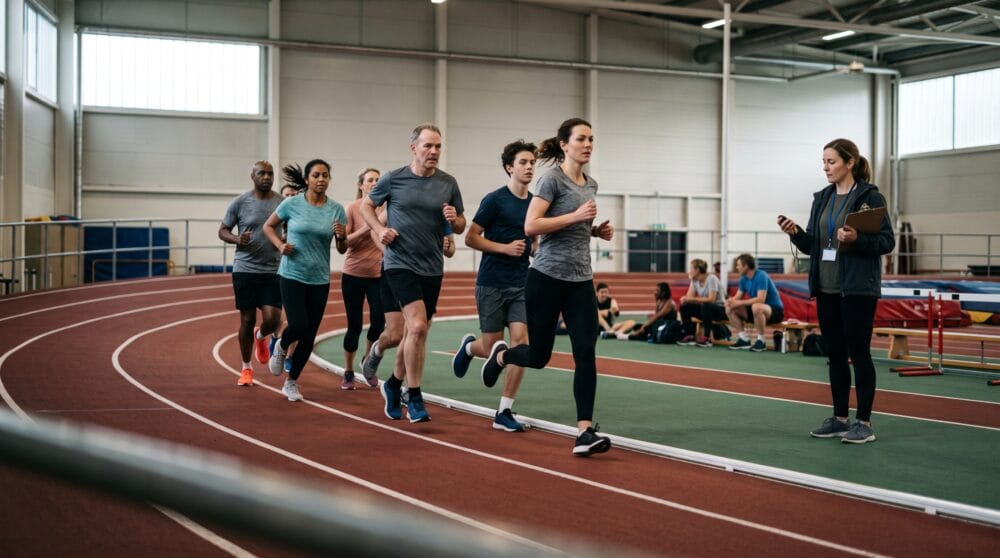
Twelve runners of mixed ability each received an individualized, adaptive Ellida plan for a 10 km race over eight weeks. Plans were built from individual profiling plus an elite coach’s philosophy, then updated in a closed loop that recalculated training zones and race predictions from completed sessions and subjective readiness.
- Predicted race time within 3.8% (≈ 100 s); predicted race heart rate within 2.8 bpm.
- R² = 0.81 between predicted and actual finish times, across 10 km times from ~35 to 60+ minutes.
- 10 of 12 runners finished within a minute of target or better, most setting personal bests.
- Consistently positive feedback on the adaptive recommendations and individualized zones.
- As a single-arm pilot, this showed predictive accuracy and real-world results under an adaptive program, but not the adaptive-versus-static effect. So we ran a controlled trial.
EVIDENCE #2: Controlled clinical trial Ellida (NCT06145152)
Using AI-generated Adaptive Training Recommendations to Improve Physical Performance is registered on ClinicalTrials.gov. Trained runners were allocated to:
- an adaptive arm, with daily sessions adjusted up or down according to readiness, or
- a static arm, with an individualized Ellida plan but no day-to-day adjustment.
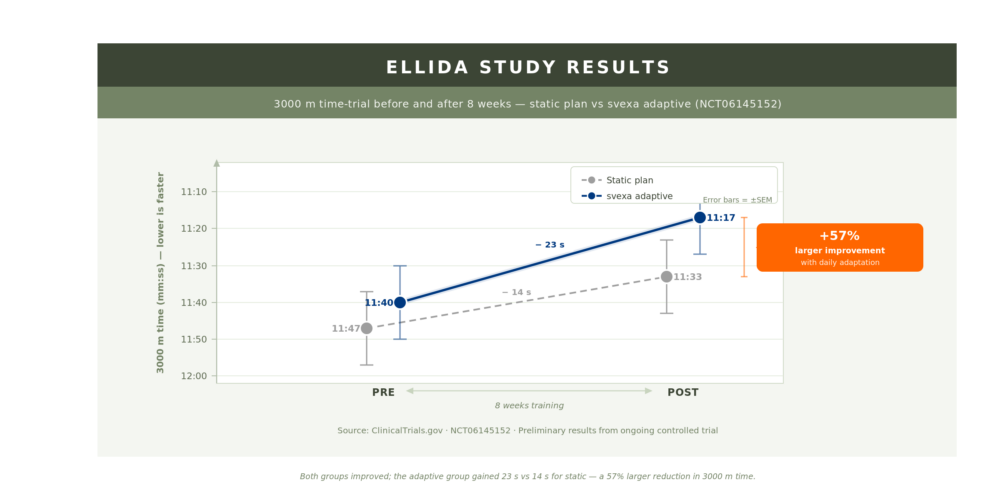
Because both groups trained on svexa-generated plans, the comparison isolates the value of daily adaptation itself. Results after 8 weeks (3000 m time trial):
- Static plan: before 11:47, after 11:33 -> improvement 14 s
- Adaptive plan: before 11:40, after 11:17 -> improvement 23 s (~57% greater gain)
- Both groups improved meaningfully in eight weeks, impressive for already-trained runners, and the adaptive group improved substantially more, consistent with the added value of readiness-based daily adjustment. (Early results: Nilsson et al., bioRxiv 2023.)
Seeing the trend, not the snapshot: overtraining research
A single fitness test, one race or a short rolling average can show where someone is, but it can’t reliably separate a real change from noise, or spot something like developing overtraining that only shows up as a pattern across several markers over time. Similarly in svexa’s peer-reviewed overtraining research, individual markers (heart-rate response, wellbeing, sleep or glucose metabolism, each considered alone) caught only a subset of overtraining cases, with meaningful false-positive and false-negative rates.
However, tracking several markers together over time substantially improved detection and performed strongly in an independent follow-up cohort (Flockhart et al., Cell Metabolism 2021; Sports Medicine Open 2022). That same longitudinal principle runs through all of svexa’s adaptive training.
FAQ
- What is an adaptive training plan?
A plan that recalculates future sessions from your latest data (completed training, recovery, readiness, performance) instead of following a fixed schedule set weeks in advance. - Is adaptive training proven to work better?
- In the ELLIDA controlled trial (NCT06145152), runners whose plans adapted daily to readiness improved their 3000 m time by 23 seconds versus 14 seconds on an individualized static plan.
- What happens if I miss a week of training?
Svexa doesn’t try to make it up by cramming. It reassesses your current state and rebuilds the path to your goal from where you actually are. - Can svexa adapt plans for teams or coaches?
Yes. The same engine powers coach platforms and, through Zone7, load management for professional teams. See [Injury risk & load](/science/injury-risk-and-load/).
Continue exploring svexa science
- Expert coaching philosophies (Seidurs)
- Performance prediction
- Injury risk & load (Zone7)
newsletter signup
Once in a while we send our subscribers a newsletter with corporate news, useful industry information or just a sneak peek of what we’re doing at svexa.