
built on research proven in the real world
Svexa’s algorithms are developed and validated in our own prospective research studies, with gold-standard laboratory testing, and then refined across years of commercial deployments in elite sport, consumer platforms and health programs.
413
participants in svexa’s
disclosable research cohorts
disclosable research cohorts
14-89
age range, from
adolescents to older adults
adolescents to older adults
6
prospective and
observational cohorts
observational cohorts
Millions
of real-world observations
from client deployments
from client deployments
Why breadth matters more than headcount
In an adaptive, physiology-first system, the range of people a model has been tested on matters more than the raw number of subjects. Showing that the algorithms hold up from sedentary workers to Olympic athletes, across ages 14 to 89 and multiple sports, is what demonstrates that the foundational physiology generalizes, and that new users get safe baselines before individual tracking takes over.
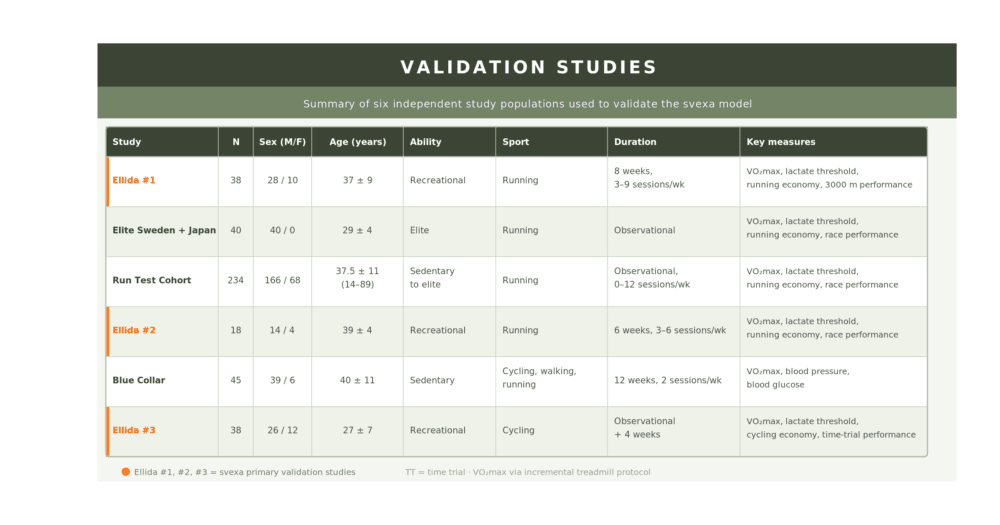
Our research cohorts
Svexa and partners have conducted laboratory and field research studies across a variety of topics and populations.
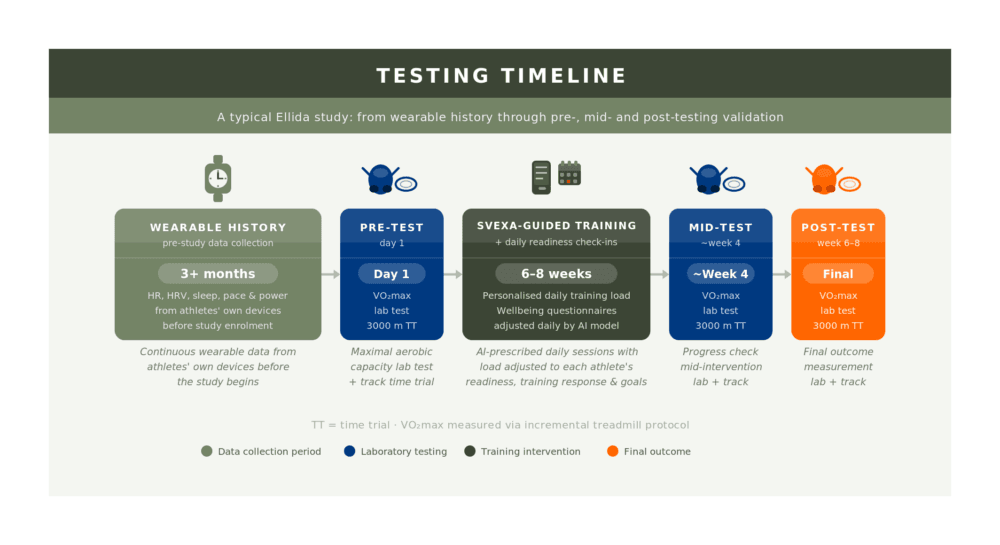
How we measure: gold-standard protocols
Participants contributed at least three months of wearable training history (heart rate, speed, duration, cadence, elevation) alongside rigorous reference testing:
- Laboratory VO₂max and thresholds: a graded treadmill protocol to volitional exhaustion on a Jaeger Oxycon Pro metabolic cart, with breath-by-breath gas analysis. VO₂max is the highest 30-second rolling average, confirmed by standard criteria (VO₂ plateau, respiratory exchange ratio above 1.10, near age-predicted maximal heart rate). Ventilatory thresholds VT1 and VT2 are identified from ventilatory equivalents and end-tidal gases.
- Field performance: an outdoor 3000 m time trial, a real-world measure of running fitness.
- Individual zones: heart-rate zones derived from combined lab and field results.
- Daily readiness: a standardized nine-item questionnaire covering recovery, training load, illness, injury, sleep, mood, energy, nutrition and mental stress.
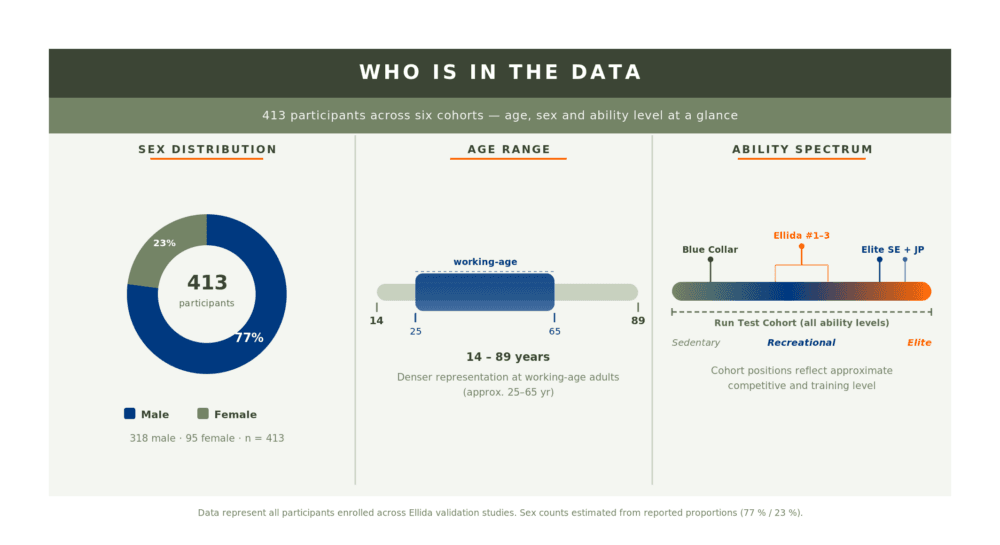
Who is represented
- Sex: 413 individuals across the six cohorts: 313 male (77%) and 100 female (23%).
- Age: 14 to 89 years, covering adolescence, adulthood and older age. Most participants are working-age adults, and age-specific performance is an area of ongoing characterization.
- Fitness and engagement: from sedentary (Blue Collar, low engagement) through regular recreational exercisers (Ellida, medium) to highly trained competitive athletes (elite cohort, high), with the Run Test Cohort spanning the full range.
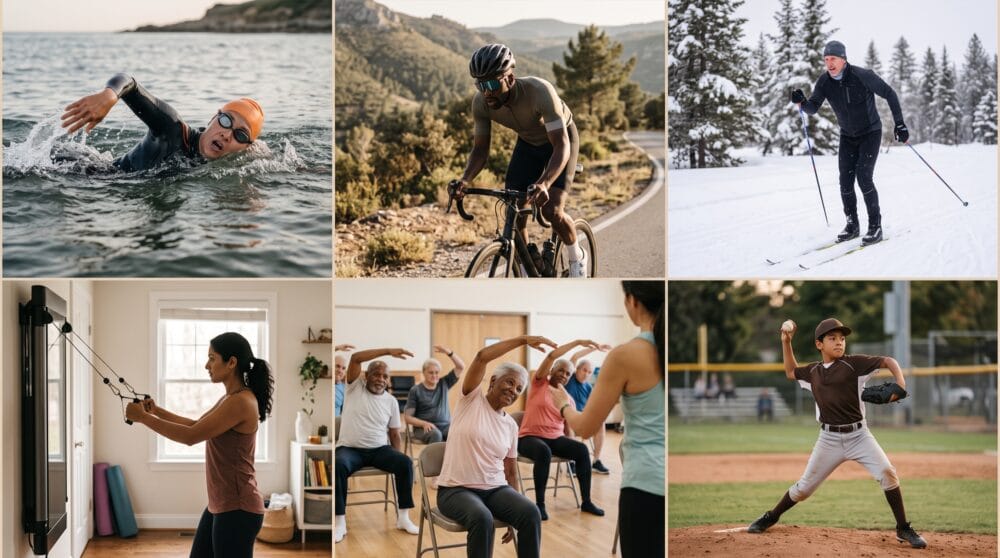
Sports and activities covered
- Running: the most extensively studied sport, and the basis of our race-prediction and endurance-training algorithms.
- Swimming and cycling: single-sport work with high-engagement athletes at similar precision.
- Cross-country skiing: studied too; a less standardized sport, with correspondingly lower accuracy.
- Multisport and triathlon: programs that juggle availability across several sports and use a proprietary integrated load metric to build and adapt the plan.
- Strength training: algorithms developed with manufacturers of connected in-home gym systems, from baseline strength testing to initial weight setting and progression.
- General health: walking, cycling and running in sedentary workers, extended in Senior Living programs that combine cardio, strength and group sessions such as chair yoga.
- Skill acquisition: adaptive training engines for golf, soccer and baseball pitching, live in market.
Proven in the field – real world deployments
Controlled studies are only half the story. A substantial share of svexa’s model development and fine-tuning comes from commercial deployments across consumer training platforms, professional sport, and hardware and software partners. Across these engagements, svexa’s systems have processed training, physiological and contextual data from many thousands of users over multi-year periods: millions of individual observations of heart rate, pace and power, strength sets, sleep, readiness, completed sessions and outcomes.
Publicly disclosed engagements include:
- RaceID: personalized, adaptive training plans for race participants, powered by Ellida.
- MATS (“Most Advanced Training Solution”): an all-in-one platform for athletes and coaches, with svexa as its intelligence layer.
- Activio: heart-rate monitoring hardware that licenses svexa’s algorithms.
- Bridges of Sports: a community sports-participation charity.
- Werder Bremen: individualized Player Passports® and injury-prediction models.
- Liverpool FC: men’s, women’s and Under-23 teams used Zone7 (part of svexa) injury-risk detection and load monitoring.
- Swedish Swimming Federation: national-team training optimization and race-time prediction.
Many more relationships, across wearables, connected strength equipment, corporate wellness and professional sport, remain confidential at our clients’ request.
Aggregate model performance is monitored continuously across this base. When a systematic pattern appears, such as a consistent bias in one population, sport or device type, it feeds back into model refinement. So when svexa arrives in a new product, it is already informed by millions of prior data points.
Our commitment to transparency
We publish sample sizes, sex and age splits, and known limitations, because credible science requires it. Where development and evaluation draw on overlapping datasets, they are separated at the analytical level, and independent prospective validation is reported separately where available.
FAQ
- How is svexa’s AI validated?
Through prospective studies with repeated laboratory and field testing (VO₂max, thresholds, economy, time trials), observational cohorts from sedentary to elite, and continuous monitoring across commercial deployments. - Why doesn’t svexa publish total user numbers?
Most deployments are under client non-disclosure agreements. We publish the research cohorts we are free to share in full. - Does svexa work for women and older adults?
Yes. Both are represented in our cohorts (ages up to 89). We have specific algorithms that adjust for factors including menstrual cycle.
Continue exploring svexa science
newsletter signup
Once in a while we send our subscribers a newsletter with corporate news, useful industry information or just a sneak peek of what we’re doing at svexa.