Why Rest Is Part of Training
The adaptation to exercise does not happen during training. It happens after training, during sleep, rest, and recovery. That’s when the body repairs the microscopic damage caused by exercise, synthesizes new proteins, expands mitochondrial density, and fortifies the neuromuscular system to handle greater loads in the future. Training without adequate recovery is not dedication. It is a failure to complete the adaptation cycle. This is the most underappreciated principle in all of endurance sport. Athletes who consistently train through fatigue without building adequate recovery into their program are not getting fit faster, instead they are accumulating fatigue while simultaneously preventing the adaptations that training is designed to trigger.
The Physiology of Recovery
Recovery from endurance training operates across multiple physiological systems simultaneously:
- Glycogen resynthesis: Muscle and liver glycogen depleted during exercise replenishes within 24–48 hours with adequate carbohydrate intake. High-volume training days deplete glycogen more fully; incomplete resynthesis before the next session compounds fatigue.
- Muscle protein synthesis: Resistance exercise and high-intensity efforts cause myofibrillar protein damage. Repair and synthesis require 24–72 hours, with protein intake quality and timing significantly influencing the rate.
- Neuromuscular restoration: High-intensity efforts reduce motor unit recruitment capacity and neuromuscular transmission efficiency. Recovery here typically requires 24–48 hours after moderate sessions and up to 72–96 hours after maximal efforts.
- Hormonal rebalancing: Cortisol (the primary exercise stress hormone) must return to baseline before anabolic hormones (testosterone, IGF-1) can resume their adaptive functions. Chronic cortisol elevation, the hallmark of overtraining, directly suppresses these anabolic processes.
- Autonomic nervous system recovery: The parasympathetic nervous system, reflected by HRV, requires time to regain dominance after high training loads. This is the primary physiological signal used in HRV-guided training.
Active Recovery vs Passive Rest: What the Evidence Says
For most athletes, complete inactivity (“passive rest”) on recovery days is less effective than low-intensity “active recovery” – gentle movement at very low effort that promotes blood flow, reduces muscle soreness, and maintains movement patterns without adding physiological stress. The key word is “very low intensity.” Active recovery means a 30-minute walk, a gentle 20-minute easy spin, or a slow yoga session – not a moderate-intensity aerobic jog because “I feel fine today.” Research consistently shows that intensity on recovery days is the critical variable; volume matters much less. A 45-minute very easy jog is physiologically superior to a 20-minute moderate-effort run for recovery.

Sleep: The Most Powerful Recovery Tool Available
Sleep quality and quantity are the single most powerful recovery variables within an athlete’s control, yet they are the most systematically undervalued. A 2011 study by Mah et al in Sleep demonstrated that extending sleep to 10 hours per night over 5–7 weeks produced significant improvements in sprint times, reaction time, and subjective wellbeing in elite basketball players – without any change in training load. The sleep mechanisms driving these improvements include:
- Growth hormone release: Approximately 70% of daily growth hormone secretion occurs during deep (slow-wave) sleep. GH drives tissue repair and protein synthesis – the foundation of training adaptation.
- Memory consolidation: Motor skill learning, the technical improvements that distinguish experienced athletes, is consolidated during sleep. Sleep deprivation impairs motor learning disproportionately compared to other cognitive functions.
- Inflammatory regulation: Chronic sleep restriction elevates systemic inflammatory markers (IL-6, TNF-alpha) that impair recovery, increase injury risk, and reduce performance.
Knowing When You Need Rest
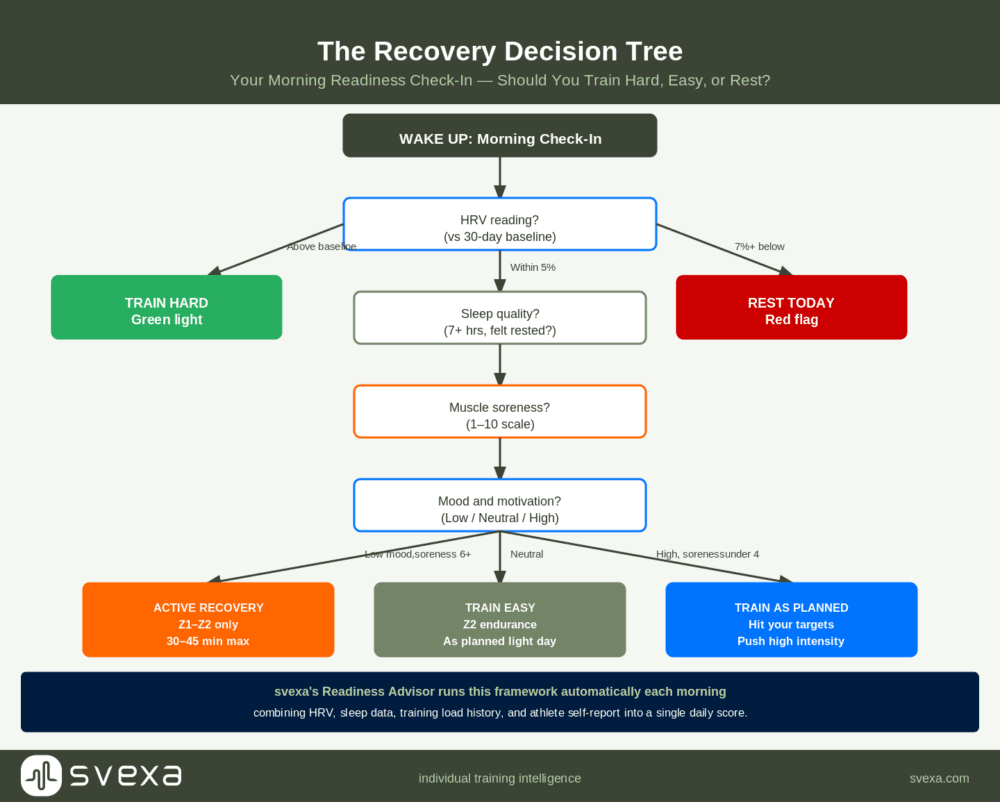
The challenge most athletes face is not knowing that recovery matters, it is knowing when they specifically need more of it. The physiological signals that indicate a rest day is warranted include:
- HRV more than 1 standard deviation below your rolling 7-day average
- Resting heart rate elevated more than 5–7 bpm above baseline
- Perceived fatigue score of 7 or above on a 1–10 scale despite adequate sleep
- Muscle soreness that is worse than the day after a hard session
- Mood disturbance, motivation loss, or unusual irritability
- Performance metrics (pace, power, stroke rate) failing to respond to a normal warm-up
Svexa’s Readiness Advisor provides a great indicator that you might need more rest. It asks a simple but powerful battery of daily subjective questions, running your responses through our algorithm built on decades of research. It delivers a single daily readiness score, along with training or recovery advice. In our wider training solutions the Overtraining Detection module flags accumulated fatigue before it reaches performance-limiting levels.
Download the free Readiness Advisor for iOS or Android now. Contact Us any time to discuss more.