Making the Business Case for Performance Technology Investment
Sports performance directors increasingly find themselves in a dual role: their primary responsibility is optimising athletic performance, but their operational effectiveness depends on making financial arguments that satisfy CEOs, CFOs, and boards who think in terms of revenue, wage budgets, and return on investment. The emerging generation of performance technologies, from AI-powered injury prediction to integrated monitoring platforms, delivers genuine value, but that value is not always easy to articulate in the financial language that decision-makers require. This framework provides a structured approach to quantifying the ROI of athlete performance technology investment, designed to support the business case conversations that performance directors have with club leadership. The methodology draws on published research on injury economics in elite sport combined with practical frameworks from clubs that have successfully made these arguments.
The True Cost of a Soft-Tissue Injury: More Than Salary Continuation
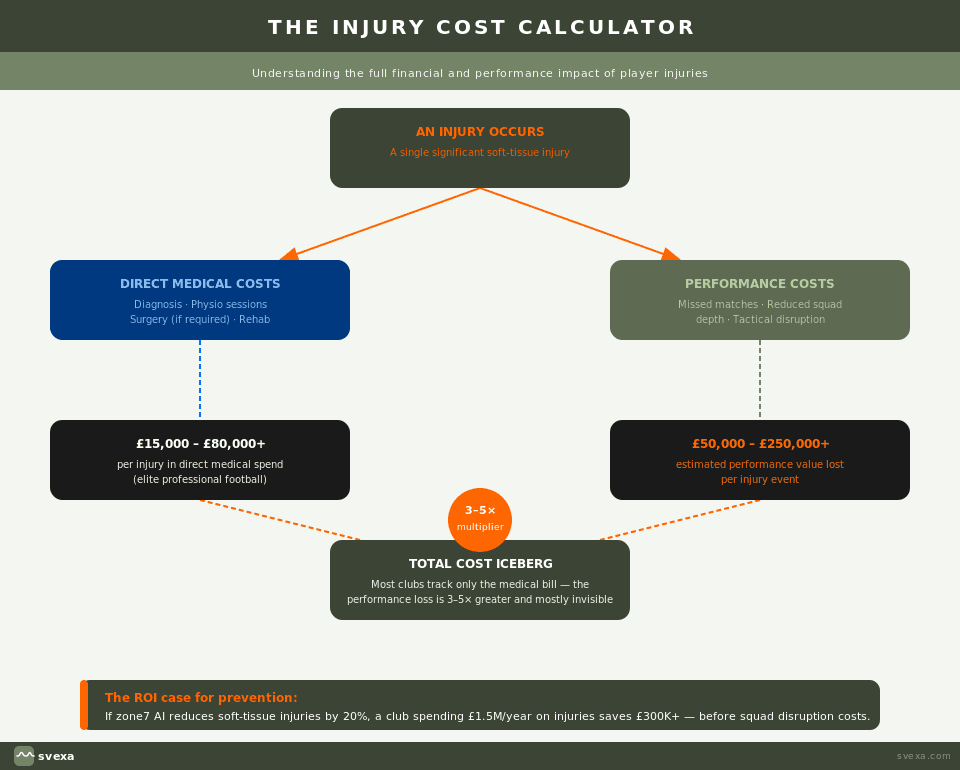
The default financial framing of sports injury, salary continuation during absence, dramatically underestimates the true economic impact. A rigorous accounting of the cost of a single significant soft-tissue injury (for example, an eight-week hamstring strain in a key attacker) should include:
- Direct costs: Full salary during absence + physiotherapy sessions (typically 3–5 per week) + medical investigation costs (imaging, specialist consultations) + rehabilitation equipment costs
- Squad disruption costs: Increased playing time and associated wear for replacement players, increased training loads on remaining squad, tactical limitations from missing key personnel
- Match performance value: Statistical modeling of the performance contribution of absent players (expected goals, defensive metrics, pass completion) translates absence into a goal-equivalent figure, and from there into expected league points and their financial value
- Potential secondary injury costs: Overloaded replacement players face elevated injury risk, potentially triggering cascading injuries
- Morale and cohesion costs: Team cohesion research consistently demonstrates that sustained key-player absence depresses group performance through psychological channels beyond the direct athletic deficit
As an example – in Premier League terms, independent research estimates the all-in cost of a significant injury to a first-team player at £500,000 – £2 million per episode for mid-table clubs, rising substantially for key players at title-challenging clubs where the marginal value of a match result is highest.

A Framework for Calculating Performance Technology ROI
Step 1: Calculate Your Baseline Injury Economics
Using the last three seasons of injury records, calculate: average number of significant soft-tissue injuries per season; average absence duration; all-in cost per injury episode using the categories above. This establishes the baseline against which technology ROI is measured.
Step 2: Apply Evidence-Based Injury Reduction Estimates
AI-powered injury prediction systems have demonstrated consistent injury reduction rates of 15–30% in published and operator-reported data. For your ROI calculation, use the conservative end of this range (15%) to avoid over-promising. Apply this to your baseline injury cost calculation: a club spending £4 million per season on soft-tissue injury costs could expect to recover £600,000 annually from a 15% reduction.
Step 3: Add Performance Value of Improved Availability
Beyond injury cost reduction, improved squad availability has a direct performance value. Use the research finding that squad availability rate correlates significantly with league finishing position to estimate the performance premium of a 5–10% improvement in availability for your squad.
Step 4: Calculate Net ROI
Compare the total annual value from steps 2–3 against the annual cost of the technology platform (license fee + implementation + staff time). For most elite clubs, the ROI calculation favors investment substantially, even on conservative assumptions.
Beyond the Numbers: Strategic Value
Financial ROI calculations inevitably simplify what are genuinely complex, multi-dimensional value questions. The strategic value of performance technology investment includes dimensions that are difficult to monetise directly: the talent attraction premium of demonstrating world-class performance science infrastructure to prospective signings; the early identification of emerging talent from academy monitoring data; and the institutional knowledge advantage of longitudinal data assets that compound in value over time.
Zone7 by svexa is designed to exactly deliver on this promise of ROI, by enabling coaches or performance staff to understand and manage their roster risk on a daily basis. They can see which individual players are at elevated risk, understand their unique individual risk factors, then simulate the effect of proposed training changes to mitigate the risks. Read how Zone7’s approach has delivered measurable availability improvements across professional clubs in the Soccerscene feature on Zone7, or Contact Us any time to discuss how we could help your team manage risk.