The Wearable Revolution in Recovery Science
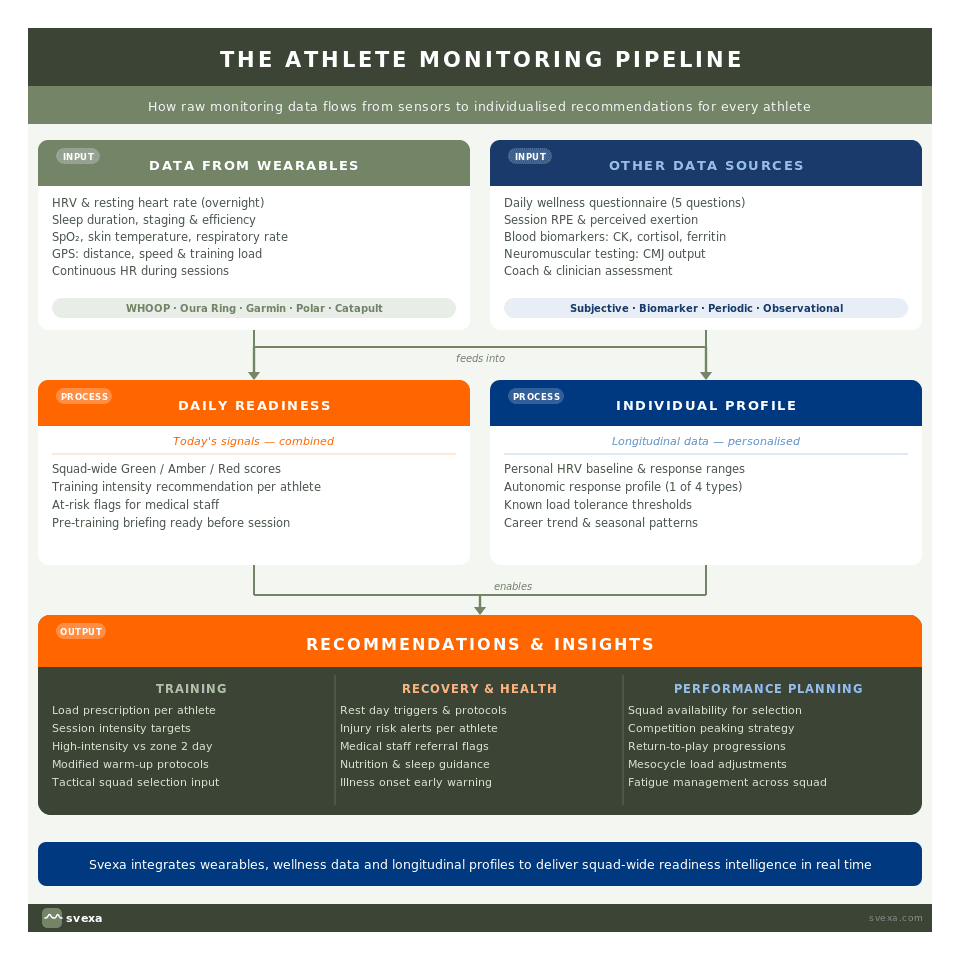
The past decade has seen a profound shift in how sports organizations approach athlete recovery monitoring – starting from elite levels but not filtered down to recreational teams, schools and individuals. Where once recovery assessment relied on subjective wellness questionnaires, periodic blood tests, and coach observation, the proliferation of commercial wearable devices has created a new data landscape. WHOOP, Oura Ring, Garmin, Polar, and a growing range of specialist sports monitoring devices now continuously capture heart rate variability, sleep stages, skin temperature, respiratory rate, and movement patterns, providing a stream of recovery-related data at a scale and frequency that was simply not possible before. The challenge for performance staff is not the absence of recovery data. It is the presence of too much data, from devices with varying levels of scientific validation, combined with insufficient frameworks for interpreting what the data means and responding to it appropriately. This tsunami of data was actually one of the drivers for svexa’s founding in 2018, it’s exactly the challenge we seek to solve. This guide addresses both the genuine value and the real limitations of wearable recovery monitoring.
Heart Rate Variability: The Gold Standard and Its Caveats
Heart rate variability (HRV), the variation in time between successive heartbeats, reflecting autonomic nervous system balance, is the most scientifically validated non-invasive recovery marker currently available. It’s typically thought that when the parasympathetic (recovery) system is dominant, HRV is high; when the sympathetic (stress) system is activated by fatigue, illness, or psychological stress, HRV suppresses. Though leading edge research by svexa’s science team has shown that it’s not that simple – for a substantial portion of individuals their response is in fact the opposite of the ‘general rule’. Devices and platforms that present single-day HRV values as definitive readiness indicators are overinterpreting the data. The real key, as often the case, is that each individual must build an understanding of their own unique physiology.
Sleep Monitoring: Accuracy and Clinical Utility
Consumer wearables estimate sleep stages (light, deep/slow-wave, REM) using photoplethysmography (PPG) and accelerometry – indirect proxies for the gold-standard polysomnography (PSG) that measures brain electrical activity directly. Multiple independent validation studies have found that consumer wearables perform acceptably for detecting sleep vs wake and estimating total sleep time, but show substantially lower accuracy for sleep stage classification – particularly in separating N1/N2 light sleep from N3 deep sleep. This means that total sleep time and general sleep quality trends from consumer wearables are clinically useful, while specific sleep stage percentages from the same devices should be interpreted with caution. An athlete consistently reporting five to six hours of sleep on their Oura Ring has a genuine sleep problem worth addressing. The same athlete’s 12% deep sleep figure is less reliable and should not drive specific clinical recommendations without corroborating data.
What Wearables Are Missing
Even the most sophisticated consumer wearables do not capture several recovery dimensions that are clinically significant:
- Muscle damage status: CK elevation (the primary marker of muscle micro-trauma from training and competition) is invisible to wearables
- Nutritional recovery adequacy: glycogen replenishment, protein synthesis, micronutrient status – all invisible to wearables
- Hormonal balance: cortisol, testosterone, IGF-1 – critical recovery markers that require blood or saliva analysis
- Psychological and emotional load: the subjective experience of stress, motivation loss, and mood disturbance requires direct questioning, not inference from biosignals.
- Illness onset markers: CRP, white cell count, and other acute-phase reactants require biomarker analysis
The gap between what wearables capture and what recovery actually encompasses makes the case for integrated monitoring – combining objective wearable data with subjective wellness inputs, periodic biomarker testing, and performance testing as part of a comprehensive athlete health picture.
Building a Recovery Monitoring Protocol That Works
Best-practice recovery monitoring for elite team sports integrates data at multiple levels, contextualizes individual athlete data against their own baseline, and provides actionable outputs to coaches and medical staff in real time:
- Daily HRV and sleep data from wearables – captured overnight and available to staff before training begins
- Daily subjective wellness questionnaire – questions on fatigue, muscle soreness, sleep quality, stress, motivation etc
- Weekly GPS load review – checking acute vs chronic load ratios for the squad
- Monthly biomarker panel – ferritin, CK (baseline), cortisol, and vitamin D as a minimum
- Periodic neuromuscular testing – countermovement jump testing 2x per week during heavy training blocks
Svexa’s suite of solutions captures many of these elements – Readiness Advisor gathers a battery of critical daily subjective responses, our Digital Twin ingests data from available wearables and periodic testing to build a deep physiological profile of each individual, a key foundation for our training recommendations and insights. Our team of experts have decades of relevant experience including scientific studies with prestigious universities into the efficacy of many different wearables. Contact Us any time to discuss how we can help your team make best use of their wearables.