Why Training Load Is the Most Important Metric You Monitor
Ask any experienced performance director what single data point they would keep if they could only keep one, and most will say some form of training load. Training load, the quantified physiological and biomechanical stress imposed on an athlete by their training, underpins almost every decision in elite sport: how hard to train today, when to recover, when an athlete is ready to play, and when injury risk is accumulating to dangerous levels. Yet despite its central importance, training load is routinely misunderstood, inconsistently measured, and poorly applied in practice. This guide provides a comprehensive, evidence-based overview for performance staff at all levels, from sports scientists working with national teams to strength and conditioning coaches in high school gyms.
Defining Training Load: Internal vs External
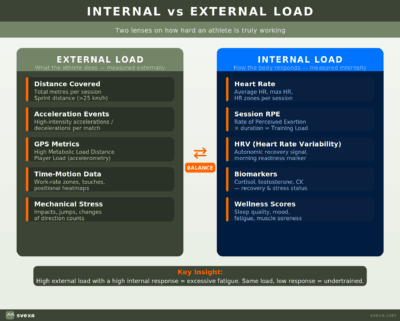
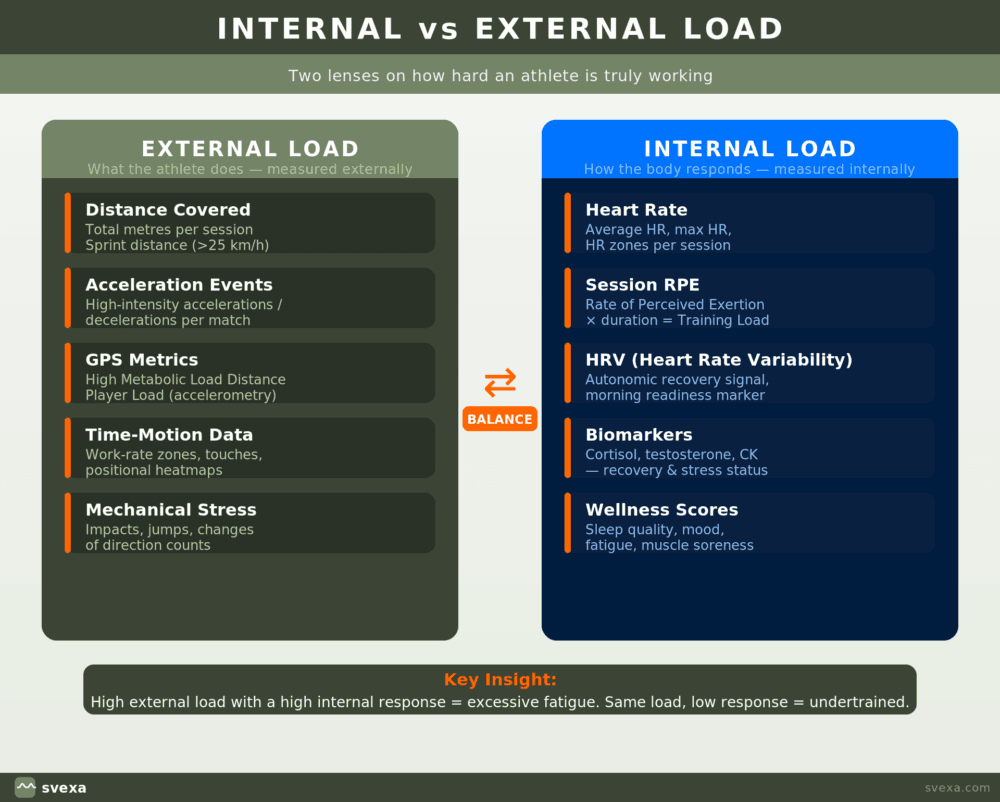
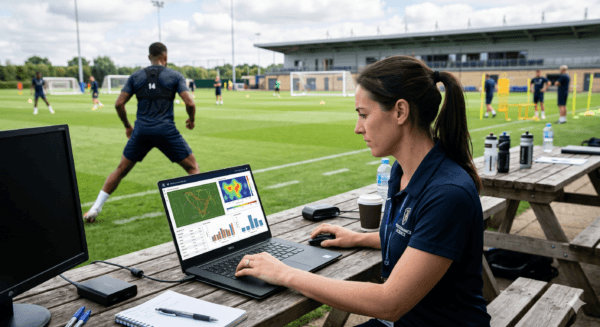
Training load has two complementary dimensions that must both be measured for a complete picture: External load refers to the work performed by the athlete, independent of their physiological response e.g. total distance covered, high-speed running distance, sprint distance, number of accelerations and decelerations, power output on the bike, or bar displacement in the gym. GPS/GNSS systems, accelerometers, and force platforms are the primary tools for measuring external load in team sports. Internal load refers to the physiological and psychological stress placed on the athlete as a result of that work e.g. heart rate, blood lactate, session RPE (rating of perceived exertion), HRV (heart rate variability), and subjective wellness scores. The same external load produces very different internal loads depending on the athlete’s fitness level, current fatigue state, ambient temperature, and psychological status. Monitoring external load without internal load context is like reading a speedometer without a fuel gauge. The athlete may be covering the required GPS distances but running on empty, and the injury risk implications are very different from the same distances covered when well-recovered.
The Acute:Chronic Workload Ratio Revisited
Despite being a fairly rudimentary measure, the acute:chronic workload ratio (ACWR) remains one of the most widely used tools for quantifying injury risk from training load. As mentioned in our previous article A guide to injury prevention in elite team sports, the ACWR compares the athlete’s most recent week of training (acute load) to their rolling 4-week average (chronic load). An ACWR of 1.0 indicates perfect consistency; values below 0.8 suggest undertraining relative to recent history; values above 1.3 are associated with substantially elevated injury risk. The conceptual power of the ACWR is that it contextualizes today’s load against the athlete’s preparation. An athlete who has trained 1,200 AU of load this week after averaging 900 AU per week for the last month is in a very different risk situation from an athlete who has done 1,200 AU this week after an injury-interrupted month averaging 400 AU, even though their absolute loads are identical.
Measuring Training Load in Practice
Session RPE
Session RPE (sRPE) is the product of session duration (minutes) and the athlete’s perceived exertion (for example on the Borg CR-10 scale). This is the most accessible internal load metric and remains highly valuable even in technologically sophisticated environments. It integrates the physiological, technical, and psychological demands of training in a single number, and takes less than 30 seconds per athlete to collect. It should be collected 15–30 minutes post-session to avoid the acute exercise effect on RPE.
Heart Rate-Based Methods
Heart rate monitoring provides real-time internal load data that sRPE cannot capture. For example, Edwards’ training impulse (TRIMP) method weights time in different heart rate zones by their physiological significance, and provides a sophisticated internal load metric well-suited to team sports. Combined with GPS external load data, HR-based methods enable calculation of the ratio between internal and external load, which is itself a useful fatigue indicator: the same external load requiring a higher heart rate response signals accumulating fatigue or subclinical illness.
GPS and Wearable Metrics
Modern GPS units sample at 10–18 Hz and provide rich external load data including total distance, high-speed running distance (typically defined as >5.5 m/s in football), sprint distance (>7 m/s), accelerations and decelerations (>3 m/s²). Each of these metrics captures different physical qualities and should be prioritized based on the specific demands of the sport and position. These GPS and wearable metrics inform svexa’s integrated load algorithm, and are often the primary source of data for svexa’s Zone7 team sports risk management and performance optimization platform.
Common Training Load Monitoring Mistakes
- Monitoring the group average rather than individual athletes: population-level load data masks the high-risk individuals
- Using absolute load thresholds rather than individual baselines: what is high for one athlete is normal for another
- Ignoring internal load: external load targets can be met while the athlete is physiologically compromised
- Failing to account for match load: competition days are often the highest load sessions and must be included in calculations
- Neglecting pre-season ramping: insufficient chronic load build-up before competitive season is one of the strongest injury risk factors
How svexa uses training load
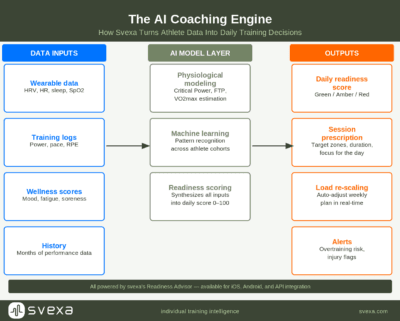
Svexa integrates all available training load metrics, including GPS, sRPE, HRV, and subjective wellness, into our single unified Digital Twin of each athlete. This then provides the basis for each of our products, ranging from Readiness Advisor module synthesizing this data into daily readiness scores, to IRMA platform providing integrated training plans, or our Zone7 platform for team sports injury risk management. Contact Us any time to discuss how svexa could help your organization measure load and optimize athlete performance.