A False Binary
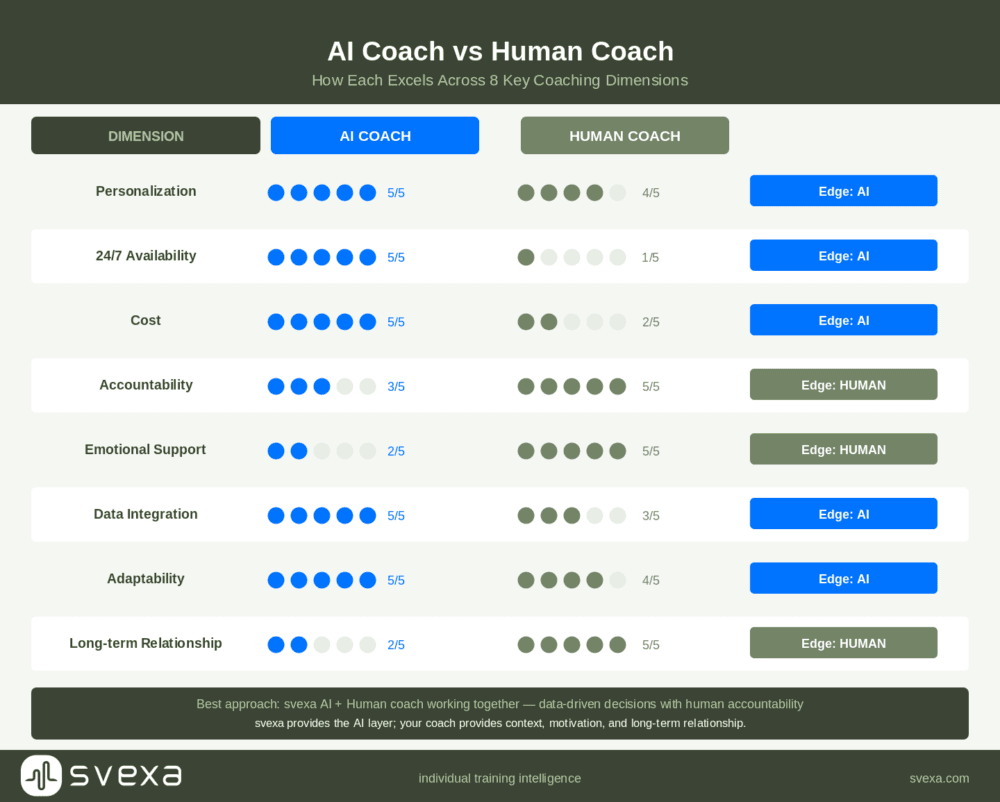
The debate over whether AI can replace human coaches is usually framed as a competition: technology versus experience, algorithms versus intuition, subscription app versus personal relationship. This framing is both inaccurate and unhelpful. The more useful question is: what does each do best, and how do athletes combine them most effectively? The honest answer from current research and coaching practice is that AI coaching systems excel at data processing, pattern recognition, load optimization and availability, while human coaches excel at motivation, contextual judgment, emotional support and relationship-based accountability. These are not competitive skills. They are complementary ones.
What AI Does Better Than Most Human Coaches
For the functions that are primarily computational, AI coaching systems already outperform human coaches in several important ways:
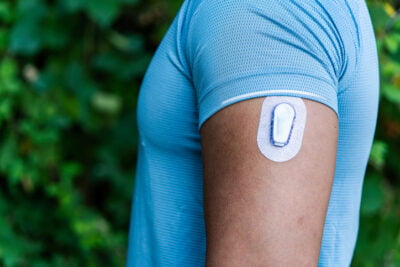
- Data integration: No human coach reviews every night’s sleep data, morning HRV reading, workout power file, and wellness score every day for every athlete. AI systems do this automatically and flag anomalies that a coach reviewing weekly notes would miss.
- Personalized zone calculation: AI platforms continuously update fitness estimates from training data, keeping zone prescriptions accurate without requiring formal testing every 6–8 weeks.
- Consistency: AI-driven training platforms do not have off days, do not forget to update your plan after a race, and are available at 11pm when you are trying to plan tomorrow’s session.
- Volume and cost: A subscription to an AI coaching platform costs a fraction of a qualified human coach. For the many athletes who cannot afford personal coaching, AI democratizes access to sophisticated training individualization.
- Longitudinal memory: AI systems maintain complete longitudinal records of every workout, every readiness score and every wellness report, creating an ever-richer model of the individual athlete that improves over time.
Svexa’s Digital Twin delivers on this promise of a deep, personalized, consistent and up-to-date physiological profile, while Irma provides the scalable (but still personalized) coaching.
What Human Coaches Do Better Than AI
The advantages of human coaching are real and significant, particularly in areas that require judgment, empathy, and relationship:
- Contextual understanding: A human coach who knows you personally understands that your HRV dropped because your mother is ill, not because you overtrained. They can distinguish between physical and psychological fatigue in ways that no algorithm reliably can.
- Motivation and accountability: Research on coaching psychology consistently shows that the human relationship – the feeling of being known, supported, and accountable to someone who cares – is one of the most powerful drivers of training adherence. An AI app cannot replicate this.
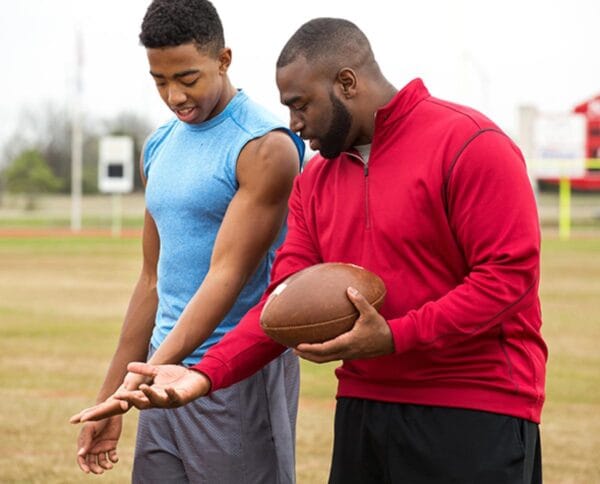
- Technical skill coaching: Running form, swim technique, bike positioning, sport-specific tactical knowledge – these require observation, feedback, and iterative correction that current AI systems don’t typically effectively. Though with the rapid advancement in image capture technology, this capability will likely arrive soon.
- Race strategy: Elite race strategy involves competitive intelligence, psychological reading of opponents, on-the-fly decision-making, and experience-based judgment that current AI systems do not possess.
- Handling the exceptional: Major life events, unusual injury patterns, mental health challenges, significant underperformance – these situations require the judgment, empathy, and creativity of an experienced human practitioner.
The Emerging Model: AI-Augmented Human Coaching
The most sophisticated coaching operations, from professional sports teams to performance-focused triathlon squads, are not choosing between AI and human coaches. They are combining them: using AI for data processing, load monitoring, and physiological analysis, while using human coaches for technical feedback, motivation, strategy, and relationships. For individual athletes who work with a coach, svexa’s Readiness Advisor or deeper training products give coaches direct access to their athletes’ readiness data, HRV trends, and load profiles – making the human coaching relationship more data-informed and more effective. For athletes without a human coach, the platform provides the physiological intelligence layer that their training has been missing.
Contact Us to explore how svexa’s IRMA integrated platform supports both individual athletes and the coaches who work with them.