The Wellness Questionnaire: Valuable, But Not Enough
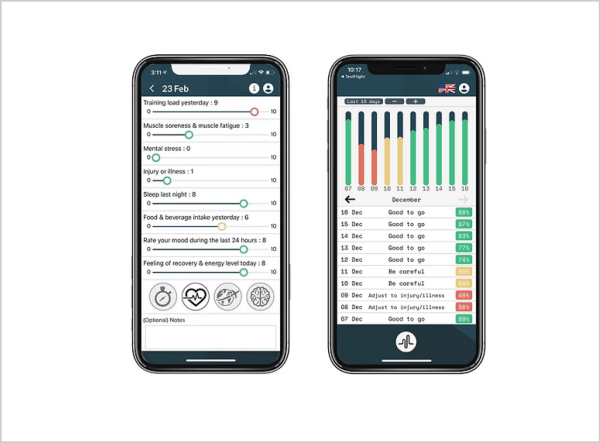
The athlete wellness questionnaire has been a cornerstone of athlete monitoring practice for two decades. A brief daily checklist, typically 5–7 items covering perceived fatigue, muscle soreness, sleep quality, stress, and motivation, rated on Likert scales, provides rapid, low-cost subjective data that has demonstrated genuine predictive value for training performance, injury risk, and illness in multiple research contexts. Any high-performance program that does not collect subjective wellness data from its athletes is leaving useful information on the table. Svexa’s Readiness Advisor makes this easy, uses carefully tailored questions to feed our our proprietary algorithm and deliver a daily readiness score and guidance.
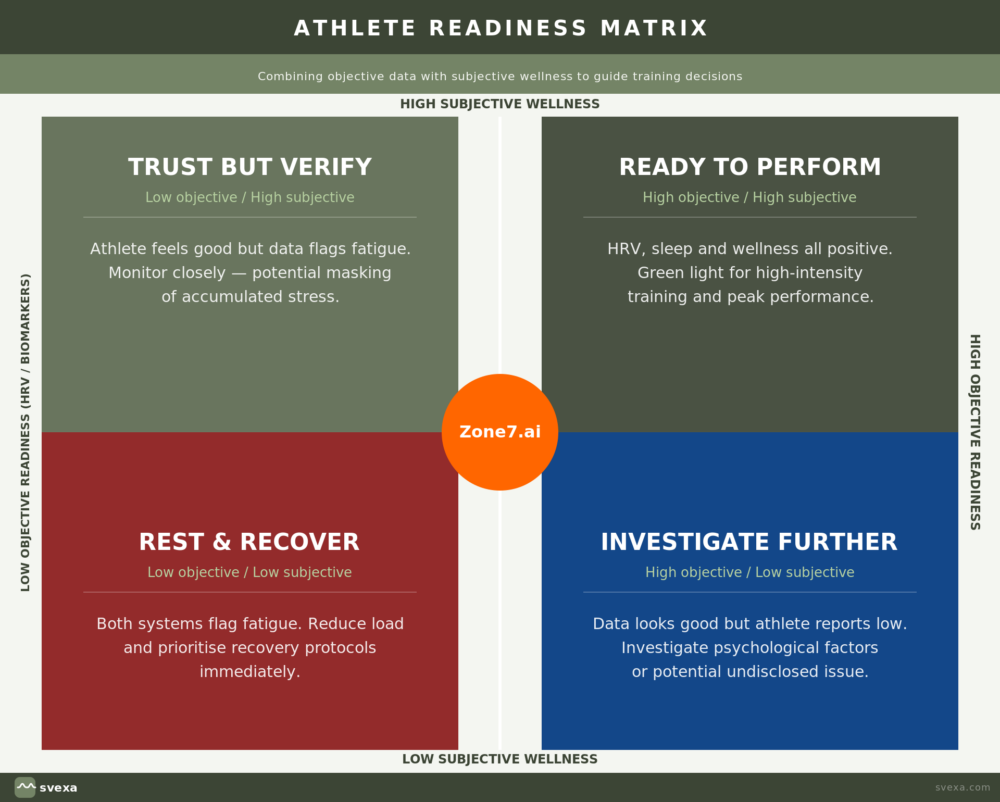
The problem is not with wellness questionnaires per se. The problem is with treating them as sufficient, as though an athlete who rates their wellness a 4/5 on all scales is genuinely ready for high-intensity training. Athletes self-report imperfectly for multiple reasons: social desirability bias (not wanting to appear soft), insufficient introspective awareness, reporting fatigue as normal when it is actually subclinical illness, and the simple human tendency to compress all experiences into the middle of a scale. Wellness questionnaire data should be treated as one valuable input among several, not as a standalone readiness determination.
What Readiness Actually Means: A Multidimensional Model
Athletic readiness, the capacity to perform at high intensity with low injury risk and effective training adaptation, is the product of multiple physiological systems operating in concert. A complete readiness assessment must capture:
- Neuromuscular readiness: The capacity of the central and peripheral nervous system to generate force and coordinate movement at the required level. Best assessed by jump testing (countermovement jump performance) or reaction time measures.
- Cardiovascular readiness: The capacity of the cardiovascular system to support high-intensity efforts, reflected in resting heart rate, HRV, and heart rate response to standardized submaximal efforts.
- Metabolic readiness: The adequacy of energy substrate availability (primarily muscle glycogen) for the demands of the training session. Requires approximately 48–72 hours after a high-intensity session to restore fully.
- Psychological readiness: Motivational state, cognitive capacity, and emotional regulation – all of which affect both performance and injury risk through attentional and biomechanical channels.
- Immune readiness: Freedom from subclinical infection or immune challenge that would compromise performance and elevate injury risk.
Wellness questionnaire data provides a partial window into psychological readiness and perceived fatigue. It is almost silent on neuromuscular, metabolic, and immune dimensions.
Objective Readiness Monitoring in Practice
The most practically deployable objective readiness tools for elite team sports are:
Morning HRV
A 5-minute morning HRV measurement under standardized conditions (supine, before eating, away from caffeine and alcohol) provides a sensitive, non-invasive window into autonomic nervous system state – reflecting the integration of cardiovascular, metabolic, and psychological recovery. Trends over 7–14 days are more informative than single-day values. Athletes whose HRV trend declines while training load is stable deserve immediate clinical attention, regardless of their wellness questionnaire scores. Of course nowadays many wearables will provide a continual measure of HRV, which can be a reasonable substitute for standardized testing.
Countermovement Jump Testing
CMJ testing 2–3 times per week provides a sensitive, quick-to-administer objective readiness measure. Post-match CMJ is reliably reduced by 5–15% and returns to baseline within 72–96 hours in most athletes, making it a practical fatigue timeline marker. Athletes who have not fully restored CMJ by the next training session may be at elevated injury risk during high-speed running and change-of-direction demands.
Resting Heart Rate
While less sensitive than HRV, resting heart rate elevation of 5–7 bpm above individual baseline is a readily available early warning of accumulated fatigue or subclinical illness. Most GPS and heart rate monitoring systems capture this data passively – the challenge is ensuring it is viewed and acted upon within a daily workflow.
Building a Daily Readiness Protocol
An effective daily readiness protocol integrates objective and subjective data streams into a single synthesized readiness score, delivered to coaching and medical staff before training begins. The protocol should be:
- Standardized: collected under the same conditions (time, posture, pre-measurement state) every day to reduce noise
- Brief: athlete burden of < 5 minutes total to collect all data points
- Integrated: delivered as a single combined score with supporting detail, not as five separate emails from five different platforms
- Actionable: linked to pre-agreed decision rules about what training modifications different readiness levels trigger
Svexa’s Digital Twin integrates HRV, sleep, wellness, and load data into a detailed physiological profile that is always up to date. With this in place, our Irma integrated recommendation engine provides Objective, Subjective and Integrated readiness scores to enable an optimal daily readiness protocol – giving athletes and coaches a data-synthesized answer to the readiness question every morning. Contact Us to explore how it works in more depth.