What Is an Athlete Management System?
An athlete management (or monitoring) system (AMS) is a technology platform designed to collect, integrate, and analyze data from multiple sources to track the health, readiness, and performance of athletes over time. In practical terms, an AMS serves as the central nervous system of a sports science program: it ingests data from GPS devices, heart rate monitors, wellness questionnaires, sleep wearables, strength testing, and medical records; applies analytical models to generate readiness scores, injury risk flags, and load recommendations; and delivers these outputs to coaches, medical staff, and athletes through role-appropriate dashboards. The AMS market has expanded rapidly over the past decade. What began as a niche category of specialized sports software has grown into a complex ecosystem of over 50 significant commercial platforms, ranging from simple wellness questionnaire apps to sophisticated integrated analytics platforms with AI capabilities. For sports directors evaluating this landscape for the first time, or for those considering a platform upgrade, the variety can be overwhelming. This guide provides a clear framework for understanding what an AMS does, what to look for in evaluation, and how to avoid the most costly mistakes.
Core Functions of an Effective AMS
1. Data Collection and Aggregation
The foundation of any AMS is its ability to ingest data from the tools your organization already uses, and to do so reliably, automatically, and without significant staff overhead. A platform that requires manual data entry to populate its dashboards will be underused and undervalued within months of deployment. The best AMS platforms offer direct API integrations with all major GPS hardware, HRV monitoring devices, sleep wearables, and wellness questionnaire platforms, as well as flexible CSV import for legacy or non-integrated sources.
2. Individualized Analytics
The most important analytical principle in athlete monitoring is that performance and readiness are always individual: the question is not “is this load high?” but “is this load high for this athlete at this point in their season?” An AMS that applies population-average thresholds rather than building individual baselines is providing only half the picture, and the less useful half. Look for platforms that explicitly describe how they personalize their analytical models to individual athletes, and that allow the user to see the individual baseline being used.
3. Decision Support
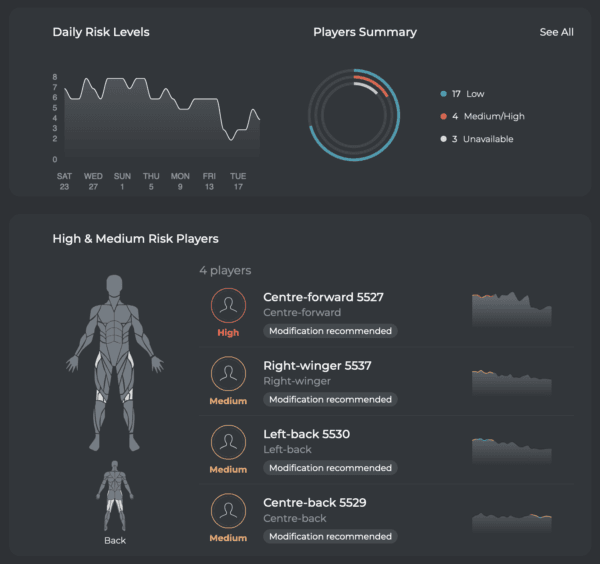
An AMS that produces beautiful dashboards without clear, actionable recommendations is a reporting tool, not a monitoring system. Effective platforms translate data into decisions: this athlete is amber for load risk this week; this player’s readiness score suggests modified session intensity today; this group of athletes is trending toward overreaching and should be assessed by medical staff. Decision support should be embedded in the platform’s core design, not an afterthought.
4. Longitudinal Data Management
The value of athlete monitoring data is not fully realized until it has been collected for multiple seasons. Long-term injury risk patterns, career development trajectories, the physiological impact of training innovations – these insights require longitudinal data that is properly structured, searchable, and preserved across staff and platform changes. An AMS that stores data in proprietary formats with limited export capability creates a strategic dependency risk; look for platforms with open data access, standard export formats, and clear contractual commitments on data portability.
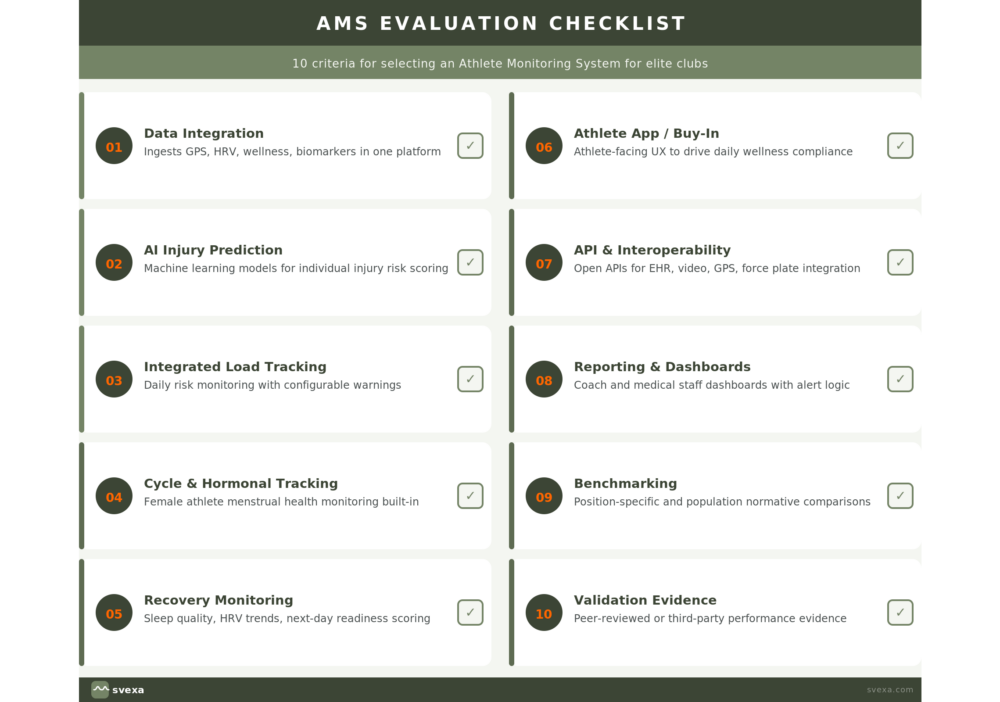
AMS Evaluation: What to Look For
Scientific Validation
The sports science AMS market contains significant variation in the quality of the analytical methodologies underpinning different platforms. Some are built on peer-reviewed, published algorithms; others use proprietary approaches whose validity is unverifiable. Before committing to a platform, ask directly: which specific analytical models are used? Are they peer-reviewed? Can references be provided? A vendor unable to answer these questions with specificity is a vendor whose scientific credentials should be treated sceptically.
Data Ownership and Portability
This is frequently the most important clause in any AMS contract and the most commonly overlooked during evaluation. Key questions: Who owns the data collected through the platform? What happens to your historical data if you terminate the contract? Can you export all data in standard formats at any time? Are there any restrictions on using exported data with a competitor platform? The principle of athlete data ownership is increasingly embedded in professional player association agreements – ensure your AMS contract is compliant.
Integration with Existing Infrastructure
Most clubs already have significant technology investments including GPS hardware, video analysis platforms, strength and conditioning tools and medical records systems. An AMS that requires replacing these systems to function is likely to be significantly more expensive to implement than its headline license fee suggests. Prioritize platforms with strong, documented integration with your existing ecosystem.
Why Zone7 and svexa Stand Apart
In the crowded AMS market, Zone7 and svexa are distinguished by a combination of qualities that are uncommon individually and extremely rare in combination: deep scientific roots, AI-first architecture, genuine API-based integration flexibility, and a commitment to athlete data ownership and portability that reflects the values of the performance science community.
Zone7’s injury prediction models were developed in collaboration with professional sports scientists and have been validated against real injury outcomes across multiple sports and leagues. Svexa’s IRMA platform was designed from the ground up as an open, modular infrastructure rather than a closed walled garden.
- Zone7 for team sports: zone7.ai
- Svexa IRMA integrated platform: svexa.com/solutions/irma
- Athlete Passport longitudinal records: svexa.com/solutions/athlete-passport
- Independent technology evaluation: svexa.com/solutions/technology-review
Ready to evaluate an AMS for your organization? Contact svexa to arrange a demonstration of the IRMA platform and Zone7’s injury prediction capabilities — and request a technology review of your current stack.