
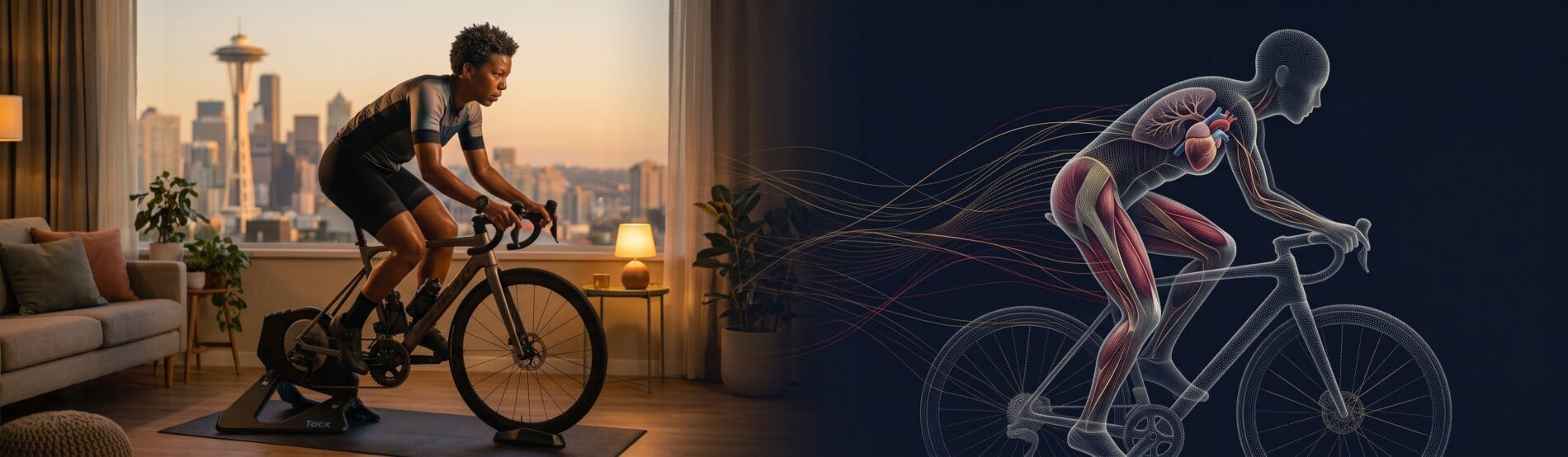
a model of you that learns from every session
Most training apps write a plan once and hope you follow it. Svexa treats training as a continuous prediction-and-control problem: every completed session, missed workout, night of poor sleep or new race result updates a physiological digital twin, and the next recommendation is recalculated from the latest picture of the person.
Daily
plan re-evaluation in Ellida,
svexa’s endurance planner
svexa’s endurance planner
20+
data signals the model can use,
from heart rate to mood
from heart rate to mood
Day 1
useful guidance for new users,
before any personal history exists
before any personal history exists
1
closed feedback loop linking
prediction and training decisions
prediction and training decisions
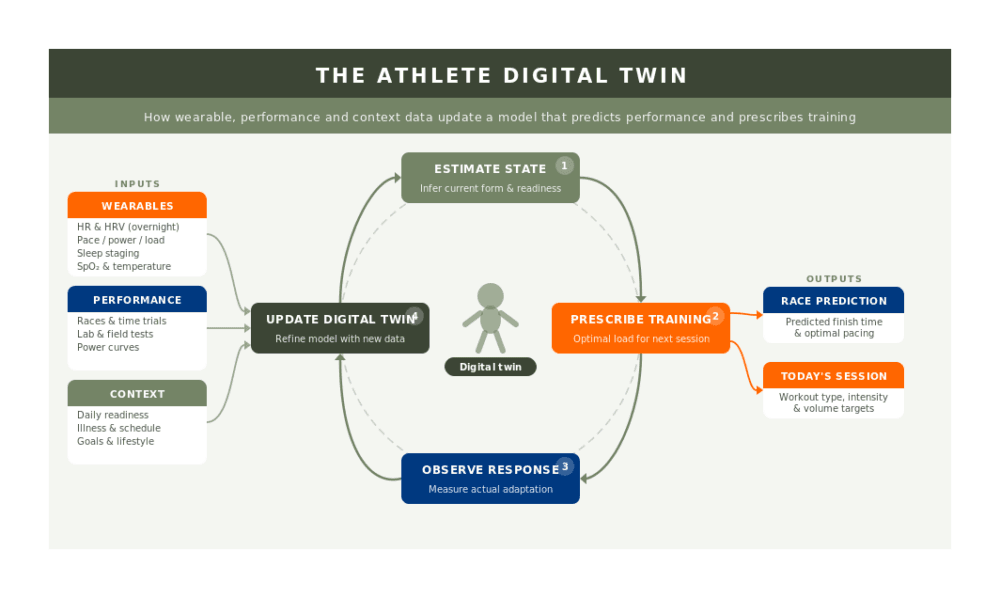
The closed loop: predict, prescribe, observe, update
Svexa’s core principle is that prediction and decision-making work together:
- Estimate the person’s current state: fitness, fatigue, recovery and expected performance.
- Prescribe the training most likely to move them toward their goal.
- Observe what actually happened: the session completed, the heart-rate response, how they felt, the next race result.
- Update the model. If performance develops differently from the prediction, the training stimulus is wrong for this person and is adjusted, whether that means changing total load or shifting the balance between high-intensity and higher-volume work.
Performance prediction is therefore not an end product. It is the evaluation tool that tells the system whether training is working.
What goes into the model
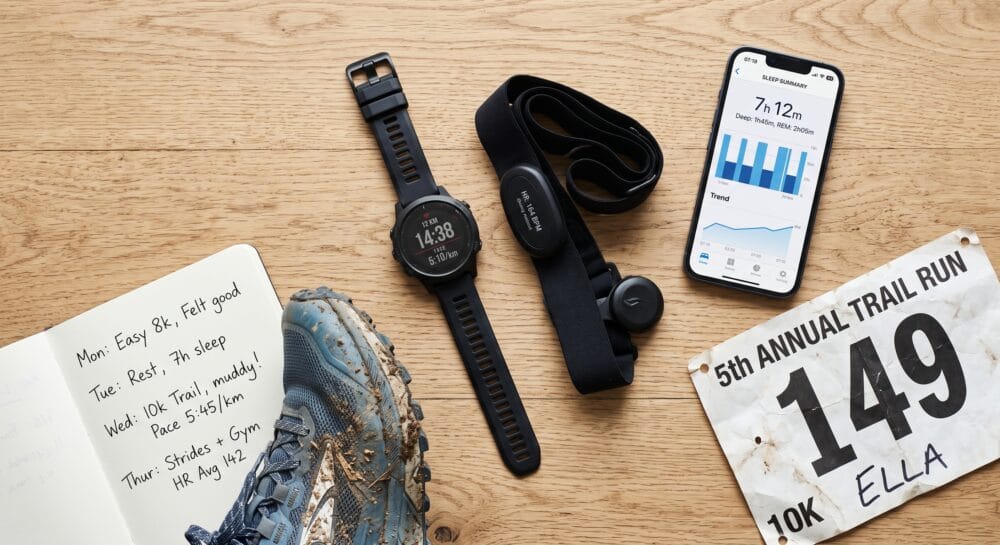
Svexa integrates three domains of data, and doesn’t need all of them to start.
- Wearable signals: heart rate, speed or power, distance, duration, cadence, elevation, sleep, resting heart rate, HRV, temperature-related measures.
- Training history and performance: frequency, volume, intensity distribution, completed and missed sessions, recent load, race results, time trials, VO₂max, thresholds and exercise economy.
- Subjective and contextual inputs: recovery and readiness, sleep quality, mood, energy, soreness, illness, injury, nutrition, stress, available training time, schedule changes, competition dates and goals.
Svexa has also developed environmental algorithms. In trail running, for example, surface type combined with temperature, humidity and elevation change can dramatically alter what a given heart rate or pace really means.

Solving the cold-start problem
Personalized systems usually face a dilemma: they need history before they can personalize, but new users want value now. Svexa handles both ends:
- Established exercisers – with months or years of history on their watch or platform get deep individualization immediately: svexa reads their training volume, intensity, performance and physiological responses from day one.
- New exercisers – start from population-level models and prior knowledge from people with similar characteristics. As their own data accumulates, its weight in the model rises until the recommendations are genuinely theirs.
Built for messy, real-world data
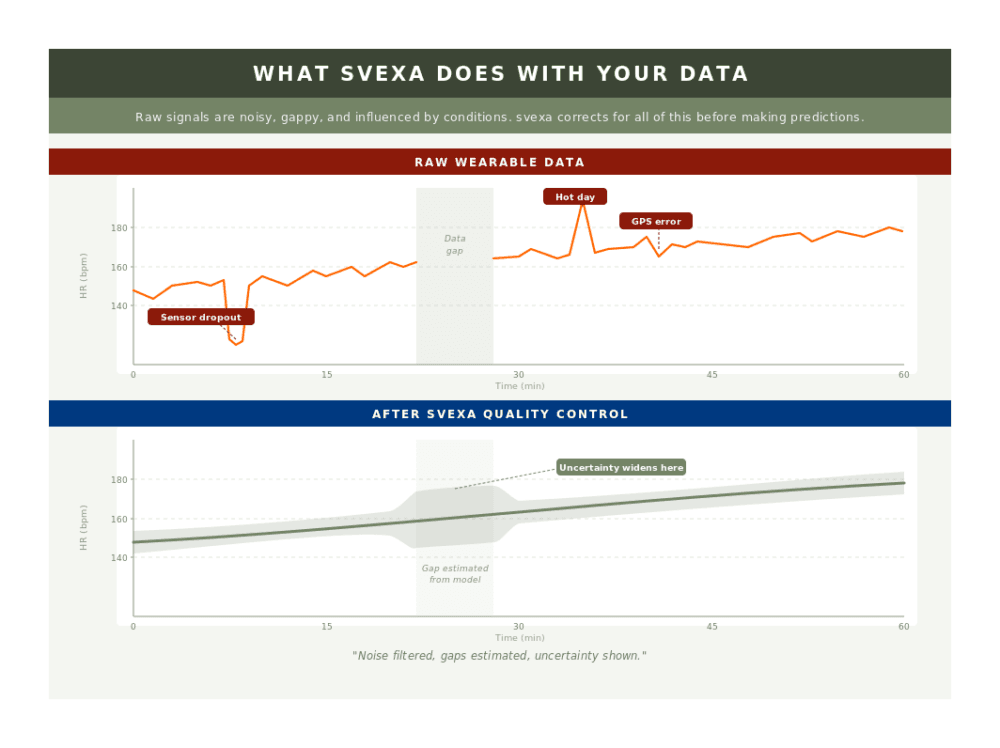
Wearable data is never clean. Devices differ, sensors drop out, users forget to charge their watch. Svexa is designed for exactly this:
- Quality control first – Statistical filtering, outlier and anomaly detection, and longitudinal time-series modeling separate genuine physiological change from noise.
- Smart estimation – A mix of machine-learning methods, including gradient-boosted decision trees, recurrent and temporal convolutional neural networks, and Kalman-filter approaches, estimate expected values and fill gaps from surrounding data and correlated signals.
- Reliability weighting – Each observation’s influence depends on its estimated reliability, learned from historical consistency, device characteristics and deviation from expected physiology.
- Personal baselines over device equivalence – Because sensors and proprietary algorithms vary between devices, svexa emphasizes within-person patterns rather than assuming every device measures the same thing.
- Honest uncertainty – Rich, consistent data gives tighter, more individual recommendations; sparse or noisy data means more reliance on population priors and more conservative advice.
Why individual beats population-only modeling
Conventional wearable algorithms vs svexa digital twin
- Calibration – One formula for everyone, plus age or resting HR vs Continuously calibrated to the individual
- Plan – Fixed multi-week schedule (“plan and hope”) vs Re-evaluated as training, recovery and performance unfold
- Data view – Snapshots: today’s score, last race vs Multi-marker trajectories over time
- Output – Descriptive scores to interpret vs Predictions that drive a specific next action
- Learning – Rarely learns from the user’s actual response vs Closes the loop between prescription and response
See the evidence for each of these on our Proof of accuracy page.
What we keep proprietary
We are open about principles and results. The detailed model architecture, feature engineering, weighting and decision logic, including the trigger logic in svexa Lab that decides when an individual’s plan updates, are core svexa IP and are not disclosed.
FAQ
- What data does svexa need to build a digital twin?
Any combination of wearable, training-history, performance and self-reported data. Heart rate plus speed or power is a strong start; more streams increase individualization. - Does svexa work across different wearable brands?
Yes. Svexa is device-agnostic and focuses on within-person patterns, so differences between sensors and manufacturers are handled rather than ignored. - How often does the model update?
Updates are event-driven rather than on a fixed schedule. In Ellida, svexa’s endurance planner, the plan is typically re-evaluated daily. - Is svexa a black-box AI?
No. It is physiology-first: machine learning sits on top of established exercise-physiology principles, which is why it gives safe baselines even for new users.
Continue exploring svexa science
- Adaptive training
- Performance prediction
- Proof of accuracy
newsletter signup
Once in a while we send our subscribers a newsletter with corporate news, useful industry information or just a sneak peek of what we’re doing at svexa.