
Heat as a Performance Tool
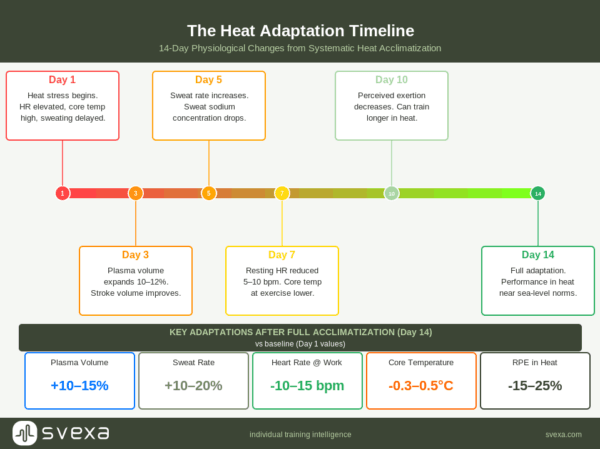
Competing in hot conditions is often treated as a problem to manage. But sports science research published over the past decade has demonstrated convincingly that deliberate heat acclimatization is one of the most effective performance enhancement strategies available to endurance athletes, and it works even for competition in temperate conditions. The mechanism is straightforward: exercising in heat triggers adaptations that improve cardiovascular and thermoregulatory function. These adaptations include plasma volume expansion (which improves cardiac output and oxygen delivery), increased sweat rate (which improves evaporative cooling), and lower heart rate at a given power output (improved cardiovascular efficiency). Critically, plasma volume expansion, a powerful driver of VO2max improvement, persists for 1–4 weeks after returning to temperate conditions, creating a legitimate performance window for cool-weather racing.
The Physiology of Heat Adaptation
Heat acclimatization initiates a coordinated cascade of physiological adaptations:
- Plasma volume expansion (Days 1–5): Blood plasma volume increases by 3–12% as the body retains more fluid to support sweat production. This is the single most performance-relevant adaptation, as expanded plasma volume increases stroke volume and VO2max.
- Improved sweat response (Days 3–10): Sweat rate increases and the onset of sweating occurs at a lower core temperature. Sweat sodium concentration decreases as kidneys retain electrolytes. The result is more efficient thermoregulation.
- Cardiovascular adaptation (Days 5–14): Heart rate at a given workload decreases as expanded plasma volume allows greater stroke volume. Resting heart rate may also drop slightly.
- Metabolic adaptations (Days 7–14): Muscle glycogen use decreases slightly at a given effort, and lactate production is reduced at submaximal intensities – adaptations partially mediated by improved cardiac output and oxygen delivery.
- Thermoregulatory recalibration (Days 10–14): Core temperature at a given workload decreases. The set-point for activating heat loss mechanisms shifts lower, meaning the body begins cooling earlier and more aggressively.
How to Implement Heat Acclimatization
The most common protocols involve 10–14 days of heat exposure, either through training in hot conditions or through passive heat exposure (hot baths, saunas) post-exercise. Research supports both approaches:
- Active heat training: Perform normal training sessions in heat (environment 35–40°C, high humidity). Intensity should be reduced by 15–20% initially to prevent excessive heat stress. Duration: 60–90 minutes per session.
- Passive heat immersion: A 30–40 minute hot bath (40°C) immediately after a normal training session has been shown to produce similar plasma volume adaptations to active heat training. This is particularly practical for athletes in cold climates or those who cannot access hot training environments.
- Sauna protocol: Post-training sauna sessions (20–30 minutes at 80–100°C, dry heat) have gained significant research support, with studies by Scoon et al. in the Journal of Science and Medicine in Sport showing 3.5% improvement in time to exhaustion and 7% increase in plasma volume over a 3-week sauna protocol.
Safety Considerations
Heat training carries real physiological risks that must be managed:
- Heat illness (heat exhaustion, heat stroke) can occur rapidly. Terminate sessions if core temperature exceeds 39.5°C or symptoms of heat illness appear.
- Hydration becomes critical. Weigh yourself before and after sessions; each kilogram of body mass lost represents approximately 1 liter of fluid deficit requiring replacement.
- Initial performance will decline – this is expected and should not trigger additional training volume. Reduce session intensity by 20–25% for the first week.
- HRV typically drops during heat acclimatization due to the cardiovascular stress involved. Use a longer rolling average (14-day) for readiness interpretation during this period.
Monitoring Heat Training Load
Heat training imposes physiological stress beyond the mechanical training load – it requires monitoring both. Svexa’s Readiness Advisor contextualizes HRV and wellness data against training load history, making it well-suited to optimize your recovery during the elevated physiological demands of heat acclimatization blocks. Contact Us any time to get more detail on svexa’s training algorithms and how they can incorporate heat based training.