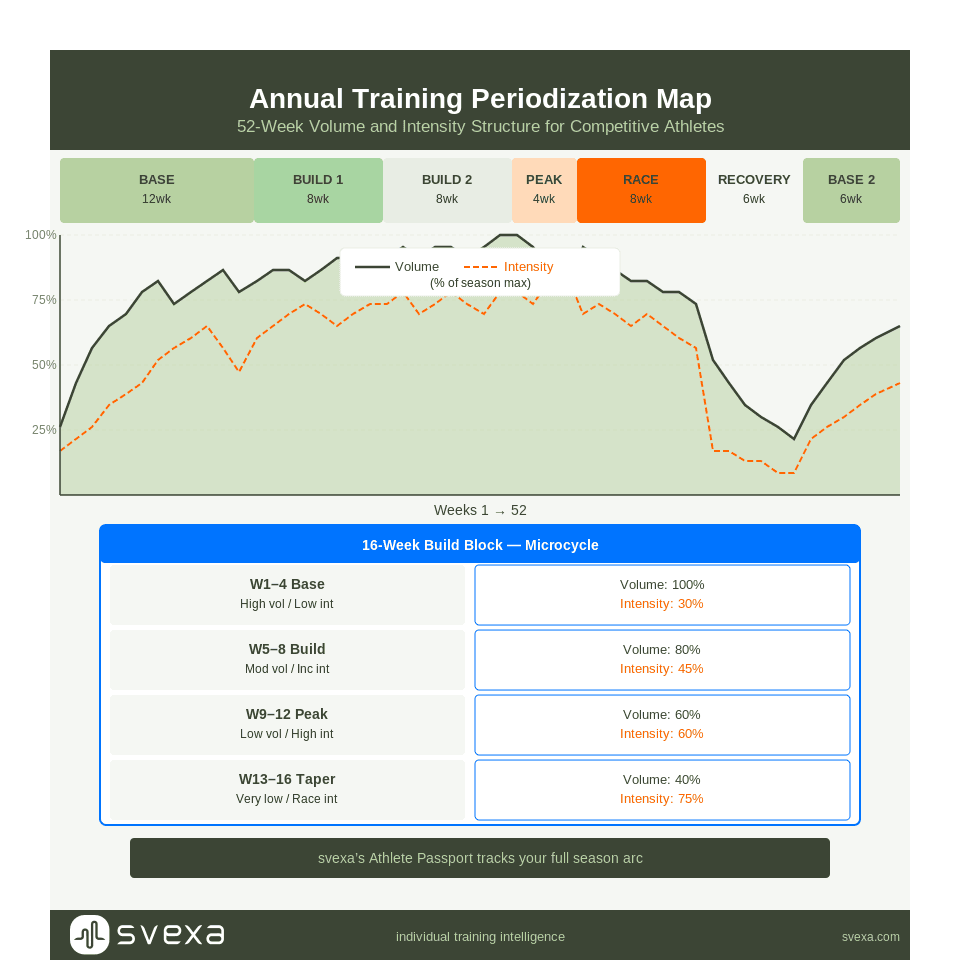
The Architecture of Athletic Improvement
Periodization is the systematic, long-term planning of training to achieve peak performance at specific target events. It is the principle that distinguishes elite athletic preparation from simply “training hard”, and it is the most evidence-supported framework in all of sports science for producing sustained performance improvement over years rather than months. The concept was formalized by Soviet sports scientist Leo Matveyev in the 1960s and has been refined continuously since. Today, multiple periodization models exist, each with different philosophies about how to distribute training stress and recovery across time. What all share is the recognition that the human body cannot train at maximum intensity indefinitely, instead it requires cycles of stimulus and adaptation, stress and recovery, specific preparation and regeneration.
The Core Periodization Phases
Traditional linear periodization divides the training year into four broad phases, each with distinct objectives:
- Base phase (General Preparation): High volume, low to moderate intensity. The goal is to build aerobic capacity, movement efficiency, and structural resilience (tendons, ligaments, connective tissue). This is where the physiological infrastructure for all subsequent training is laid. Example Duration: typically 8–16 weeks depending on event distance and athlete experience.
- Build phase (Specific Preparation): Volume maintained or slightly reduced; intensity increases progressively. Training becomes more event-specific: threshold intervals for distance runners, power-focused work for cyclists, race-simulation sessions for triathletes. Example Duration: 8–12 weeks.
- Peak phase (Competition Preparation): Training load reduces significantly (tapering) while intensity quality is maintained or increased. The goal is to arrive at the event fully recovered, with peak fitness accessible. Example Duration: 2–4 weeks.
- Recovery phase (Transition): Unstructured active recovery following competition. Essential for physical and psychological regeneration before beginning the next training cycle. Example Duration: 1–4 weeks depending on competitive calendar density.
Beyond Linear Periodization: Modern Models
Linear periodization works well for athletes targeting a single annual peak, but most competitive endurance athletes have multiple events. Several alternative models have been developed to address this:
- Undulating (non-linear) periodization: Varies intensity and volume within each week rather than across sequential phases. Suited to athletes with multiple peaks or busy race calendars. Research shows similar or superior adaptations to linear models, with potentially better maintenance of multiple fitness qualities.
- Block periodization: Concentrates training into short, specialized blocks (typically 3–6 weeks) each targeting a specific fitness quality (e.g., VO2max, threshold, muscular endurance). Popularized by Issurin for elite athletes, block periodization allows higher specificity and deeper adaptation within each block.
- Reverse periodization: Begins with high-intensity work and transitions toward volume as the event approaches – the inverse of traditional linear periodization. Gaining interest for shorter events (Olympic triathlon, criterium cycling) where absolute aerobic power matters more than extended endurance base.
Microcycles and Mesocycles: Planning at the Right Scale
Periodization operates at multiple time scales simultaneously. The macrocycle is the full training year (or season). The mesocycle is a training block, typically 4–6 weeks. The microcycle is the individual training week. Within the mesocycle, a 3:1 loading pattern is the most widely used structure: three weeks of progressive training stress followed by one week of reduced load for recovery and adaptation consolidation. The adaptation to training stimulus predominantly occurs during the recovery week – this is when the physiological changes that training provokes are actually expressed as improved fitness. The corollary is that compressing recovery weeks to do “just one more hard week” is one of the most common mistakes endurance athletes make. Skipping the recovery week prevents full adaptation from the preceding weeks and begins the next block from a less recovered state.
Individual Variation and Periodization
One of the most important insights from recent sports science research is that optimal periodization is highly individual. Athlete A may thrive with 3-week loading blocks and 1-week recovery; Athlete B may need 2-week blocks with more frequent recovery stimulus. Recovery kinetics, training age, life stress, and genetic factors all influence how quickly athletes adapt and how much recovery they require. This is exactly where data-driven, adaptive periodization engines like svexa’s Irma significantly outperforms generic templates. By continuously monitoring HRV, sleep quality, and performance markers, our adaptive training system can identify when an individual athlete has achieved sufficient adaptation to advance to the next block vs when they need more recovery before increasing load.
Svexa’s Periodization Framework
Svexa’s IRMA platform supports periodization planning at every level, from annual training structure through weekly microcycle design. It uses real-time physiological data to continually keep each athlete’s Digital Twin up to date, and adapts the plan as the athlete responds. The Overtraining Detection module provides early warning when training load is exceeding adaptation capacity, enabling proactive adjustments to the periodization plan before performance decline occurs. Contact Us any time to learn more about how svexa handles periodization.