The 16-Week Standard – and Why It’s Both Right and Wrong
The 16-week marathon training plan is the most widely used structure in recreational and competitive running. It spans roughly four months, provides sufficient time for meaningful fitness adaptation, and fits neatly within most race calendars. Almost every major marathon plan – from Hal Higdon’s beginner guides to Jack Daniels’ elite running formula – uses some version of this structure. The 16-week framework is right in that it provides an adequate training window for significant physiological adaptation given consistent execution. It is wrong in that it assumes all runners arrive at week one from the same fitness baseline and responds identically to the prescribed progression – neither of which is true. In this article we’ll review the ‘typical’ 16-week breakdown, but then highlight how svexa goes far beyond this to truly hyper-personalize your training.
Phase 1: Building the Aerobic Base (Weeks 1–4)
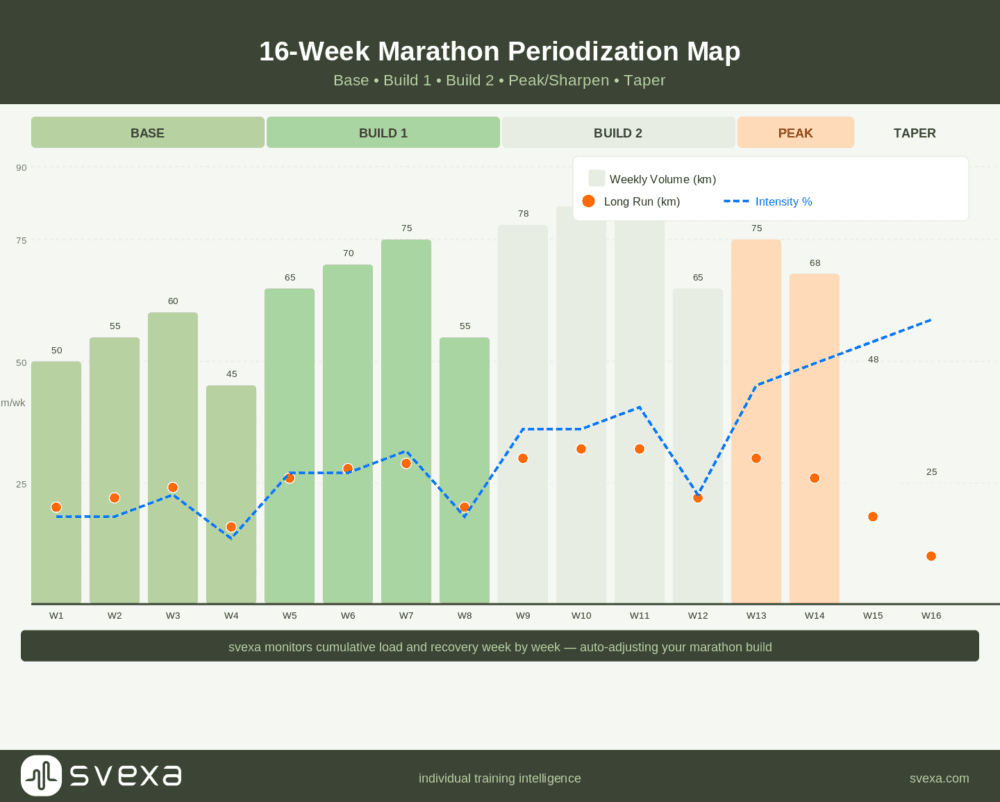
The first four weeks establish the aerobic foundation for all subsequent training. The primary focus is easy aerobic mileage – predominantly at a pace where you can hold a full conversation – with a progressively lengthening weekend long run beginning at 12–14 miles and building to 16 miles by week four.
The physiology here targets:
- Mitochondrial biogenesis: Consistent low-intensity aerobic work is the most potent stimulus for creating new mitochondria in muscle cells – the cellular engines of aerobic performance.
- Capillary development: Easy aerobic running promotes growth of new capillaries in working muscles, increasing oxygen delivery capacity.
- Connective tissue adaptation: Tendons, ligaments, and fascia adapt more slowly than cardiovascular fitness. The base phase allows these structures to adapt progressively before training load increases significantly.
Phase 2: Building Threshold Fitness (Weeks 5–12)
The build phase introduces quality work alongside continued aerobic volume. The classic structure includes:
- Lactate threshold runs: Steady efforts of 4–8 miles at marathon goal pace or slightly faster (roughly 25–30 seconds per mile faster than goal marathon pace). These runs are the most specific physiological preparation for marathon racing.
- Progression long runs: Long runs that begin easy and finish at marathon goal pace, teaching the neuromuscular system to maintain efficiency during progressive fatigue.
- VO2max intervals: Short (3–5 minute) high-intensity intervals at 5K effort 1–2 times per week develop the aerobic power ceiling, which ultimately determines how fast you can run at marathon threshold.
Training volume typically peaks in weeks 10–12, with the highest mileage week often including a 20–22 mile long run. This is the phase that determines race outcome: the fitness built here, given adequate taper, will translate directly to marathon performance.
Phase 3: Tapering (Weeks 13–16)
The taper is the aspect of marathon preparation most poorly executed by recreational runners. Training volume should reduce by approximately 20–25% in week 13, 40–50% in week 14, and 60–70% in weeks 15–16, while intensity is maintained through short, race-specific sessions. The purpose of tapering is not just rest. It is supercompensation: allowing the body to fully consolidate the adaptations from the build phase while arriving at the start line with full glycogen stores, restored neuromuscular function, and minimized accumulated fatigue. Research by Bosquet et al. in Medicine & Science in Sports & Exercise shows that optimal taper duration for marathon performance is 2–3 weeks with volume reduction of 40–60%. The most common mistake: shortening the taper because fitness anxiety drives athletes back to heavy training. Trust the science. More miles in the final two weeks will not improve performance; they will impair it.
Individualizing Your Marathon Plan
A 16-week template is a starting point, not a prescription. The most important individualization variables are:
- Current fitness baseline: Runners entering week one with a strong aerobic base can tolerate faster progression. Beginners or those returning from injury should extend the base phase and reduce the intensity of quality sessions.
- Recovery capacity: Older athletes, those with high life stress, or athletes with lower HRV baselines typically require more recovery between hard sessions and should err toward lower intensity on quality days.
- Injury history: Specific structural vulnerabilities (Achilles tendinopathy, ITB syndrome, stress fracture history) should inform load management decisions throughout the block – not just during the taper.
Svexa’s IRMA platform goes well beyond this basic framework and rudimentary adjustments. We support training for any distance, from a simple walk or ‘couch to 5k’ up to marathon or even ultra distance-specific training plans. Svexa’s system uses available historical (or new) data to build a Digital Twin based on your unique physiology, then proprietary load management and recovery algorithms to deliver your tailored training plan. With each new workout (or rest day), our plan learns from your new data and adapts to optimize your recovery and performance gain.