What the Data Reveals About How the World’s Best Cyclists Actually Train
Thanks to the explosion of power meter data sharing, GPS training logs, and a culture of relative openness among professional cycling coaches, we now have more insight into WorldTour training practices than at any point in the history of the sport. The picture that emerges is simultaneously surprising, clarifying, and directly applicable to serious amateur athletes – if you know how to read it. The insights below draw on published research examining training data from elite cyclists at the WorldTour level, including work by Seiler, Zapico, Lucia, and Rønnestad, as well as publicly shared data from professional teams.
Volume: More Than You Think, Less Than the Legend
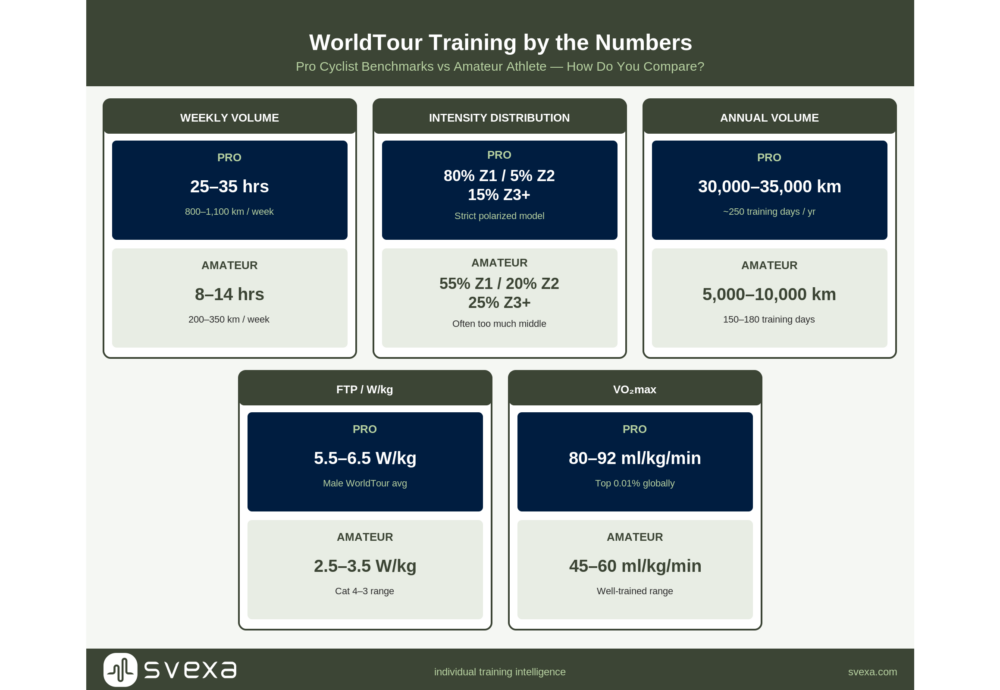
Professional cyclists ride between 25,000 and 35,000 kilometers per year – roughly 20–35 hours per week during peak training periods. This is the number that immediately seems irrelevant to athletes training 8–12 hours weekly. But the structure of how that volume is distributed is directly relevant regardless of total hours. The critical insight from research back in 2007 by Zapico et al. examining Spanish cycling professionals: even elite athletes performing 25+ hours weekly spend approximately 75–80% of that time at genuinely easy intensity i.e. below the first ventilatory threshold, at a pace you could hold a conversation. The remaining 20–25% is split between moderate and high-intensity work. A 2025 review published in Frontiers in Physiology and retrospective analyses of WorldTour riders confirm that Zapico’s original observations still hold true. For amateur athletes, this argues powerfully against the common tendency to make every session “somewhat hard.” If professionals with 30 hours weekly and full-time recovery support are performing 80% of their training at easy intensity, athletes with 10 hours weekly have even less justification for chronic moderate-intensity training.
Intensity Distribution: The Polarized Reality
Research published by Stephen Seiler examining training diaries of elite cyclists, cross-country skiers, and rowers revealed a consistent pattern: approximately 80% of training time is performed at low intensity, approximately 20% at high intensity, and very little, often less than 5%, at moderate intensity. This distribution, known as polarized training, is not what most recreational endurance athletes practice. The typical amateur cyclist spends the majority of their training at “somewhat hard” i.e. above easy but below threshold, the moderate intensity zone that is simultaneously too easy to drive significant adaptation and too hard to permit full recovery. This zone accumulates fatigue without delivering proportional fitness gains. Professional athletes avoid this “no man’s land” deliberately. Their easy days are genuinely easy (50–60% HRmax, or well below aerobic threshold) and their hard days are genuinely hard. The discipline to keep easy sessions easy is, paradoxically, one of the most difficult training skills to develop.
Key Sessions the Professionals Use
Beyond intensity distribution, WorldTour training is characterized by several signature session types that serious amateur athletes can adapt:
- The long base ride: 3–6 hours at easy endurance pace, performed weekly or twice-weekly during base phase. The duration is the point – extended time in Zone 1–2 triggers mitochondrial biogenesis, fat oxidation development, and connective tissue adaptation that shorter sessions cannot replicate.
- Over-under intervals: Alternating between 30 seconds above FTP and 30 seconds slightly below, repeated in sets of 10–20 minutes. These sessions train the body’s ability to clear lactate while maintaining power output – critical for competitive racing that involves repeated surges.
- Maximal sprint efforts: Short (10–15 second) all-out sprints with full recovery, performed 2–3 times per week even during base phase. These maintain neuromuscular recruitment patterns, fast-twitch fiber development, and maximal power output year-round.
- Race simulation: Increasingly common in the final 8–10 weeks before target events: rides that replicate race duration, elevation, and intensity patterns – including sustained efforts on key climbs that will feature in the race.
Recovery: The Professional’s Hidden Advantage
The most underappreciated difference between professional and amateur athletes is not training volume or intensity, instead it is the quantity and quality of recovery. Professionals sleep 9–10 hours nightly, nap 1–2 hours in the afternoon, have nutritional support structures designed for glycogen optimization, and have no careers or family obligations competing with recovery time.
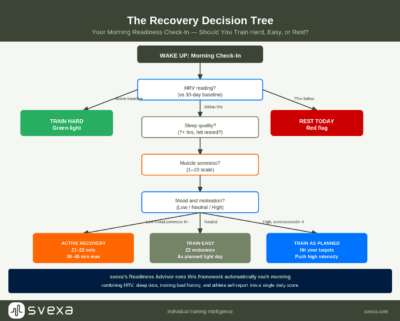
For amateur athletes, this means two things: first, the adaptations from a well-designed 10-hour amateur week can closely approximate those from a 20-hour professional week if recovery quality is prioritized. Second, the marginal value of adding more training volume is low compared to improving sleep quality, nutrition timing, and stress management.
Applying Professional Principles with svexa
Svexa’s individual performance platform applies the same monitoring and load management principles used in professional cycling teams to serious amateur athletes. The IRMA platform tracks intensity distribution, integrated workload, and physiological readiness indicators against individual baselines – giving any athlete access to the level of physiological intelligence previously available only to WorldTour teams.