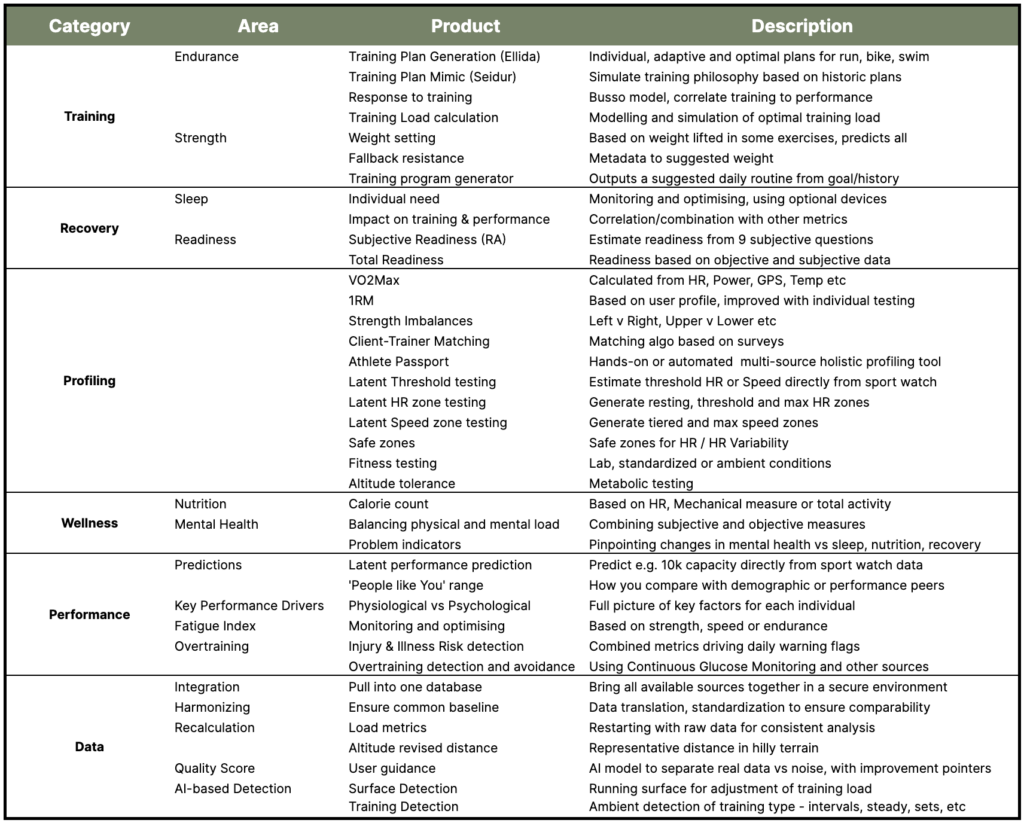
Not every performance challenge fits a standard product. Elite sport organizations, national governing bodies, defence agencies, and research institutions frequently encounter questions that require bespoke analytical approaches: custom performance models, novel physiological indicators, or the extraction of insights from unique or legacy datasets. Svexa’s Algorithms & Insights service is the expert consulting and custom development arm of the svexa offering — where world-class sports scientists and data engineers collaborate with clients to solve their hardest performance science problems. These algos are the fundamental building blocks of our wider product range – we advise clients on which would be most impactful to improve their offering, and offer these either standalone or for licensing and incorporation via API in client products.
add our insights into your products
What We Do
Custom Algorithm Development
Svexa’s scientific team designs and validates bespoke algorithms for clients with unique analytical needs. Whether developing a novel injury risk model calibrated to a specific sport’s biomechanical demands, creating a fatigue index that incorporates sport-specific neuromuscular markers, or building a performance selection model that integrates physiological and psychological variables, svexa brings the depth of expertise needed to create scientifically rigorous, practically deployable tools.
Data Analysis and Insight Generation
Many organizations collect substantial volumes of athlete data but lack the analytical capacity to extract meaningful insights from it. Svexa’s data science team can ingest historical datasets — regardless of format, completeness, or structure — and perform deep analyses that surface patterns, identify risk factors, and generate actionable recommendations. These engagements range from single retrospective analyses to ongoing data science partnerships.
Model Validation and Scientific Review
For organizations that have developed their own analytics tools internally or purchased third-party solutions, svexa offers rigorous independent scientific validation. This includes statistical analysis of model accuracy, review of methodological assumptions, comparison against published benchmarks, and assessment of real-world deployment performance. Validated models support better decision-making and demonstrate evidence-based practice to stakeholders.
Scientific Credentials
Svexa’s team brings together exercise physiologists, data scientists, biostatisticians, and domain experts with track records of publication in leading peer-reviewed journals including the British Journal of Sports Medicine, Medicine & Science in Sports & Exercise, and the Journal of Applied Physiology. This academic grounding ensures that custom algorithms are not just computationally sophisticated but scientifically sound.
Who This Is For
- National Olympic committees and high-performance programs needing bespoke performance models
- Professional sports teams requiring custom analytics beyond standard platform offerings
- Defense and military organizations applying human performance science to operational readiness
- Academic research groups seeking applied data science partnerships
- Health technology companies requiring expert algorithm review and validation
Process
Engagements begin with a discovery phase in which svexa’s scientists work with your team to precisely define the analytical question, audit available data, and scope a technically feasible and scientifically valid approach. This ensures that deliverables are useful, actionable, and grounded in the best available evidence.
Example Algorithms
- Metrics: terms like ‘load’ mean different things in each context, and often are treated differently by each provider. In order to perform effective integrated analyses, we must recalculate fundamentals like this in order to ‘harmonize’ them on the most rigorous scientific basis
- Profiling: a key pillar of svexa’s philosophy is that each individual is just that – individual. In order to generate effective training recommendations, we must first build a detailed profile of what makes each person perform, and which metrics indicate likely improvement or decline. This underpins our Athlete Passport
- Readiness: once we understand the individual’s physiological profile, we can use their incoming training and performance data to assess near-term readiness. Typically we do this on a daily basis. It can be based simply on data from our Readiness Advisor app which takes just a few seconds each day, though our algorithms will be increasingly precise as more devices or inputs feeds are added
- Warnings: using a combination metrics developed for each individual’s profile, we can generate daily flags for potential injury, illness or overtraining
- Training: knowing the athlete’s profile in combination with their goals and preferences, we can build training recommendations that range from matching individuals to trainers or setting suitable weights through to sophisticated adaptive training plans through our Ellida and Thrud products
Explore svexa’s Technology Review service for organizations evaluating existing tools, or contact the team to discuss a custom analytics engagement.