The Myth That Keeps Runners Off the Weights Floor
Ask recreational endurance athletes why they do not lift weights and the answers are predictable: it will make me heavier, it will tire my legs before my main sessions, it will not help my running or cycling. These concerns are understandable… but they are not supported by the science. Strength training for endurance is actually very valuable. A comprehensive 2017 meta-analysis by Blagrove, Howatson & Hayes in Sports Medicine analyzed 24 studies examining strength training in endurance athletes and found consistent, significant improvements in running economy (the metabolic cost of running at a given pace) of 2–8%, time trial performance improvements of 2–5%, and meaningful improvements in peak power output – all without significant body mass increases in trained endurance athletes.
Why Endurance Athletes Need Strength Training
The performance benefits of strength training for endurance athletes operate through several distinct mechanisms:
- Improved running economy: Stiffer tendons (developed through heavy strength training) improve the storage and return of elastic energy during the running stride. Stronger hip extensors and ankle plantarflexors reduce the metabolic cost of maintaining running form under fatigue. Research by Storen et al. showed that heavy strength training improved running economy by 5% and time to exhaustion at maximal aerobic speed by 21.3% in well-trained runners.
- Increased cycling efficiency: Greater maximal strength capacity reduces the relative effort of each pedal stroke, lowering the physiological cost of submaximal cycling power outputs. A 2010 study by Rønnestad et al. showed that 12 weeks of heavy strength training improved 45-minute cycling performance by 8% in competitive cyclists.
- Injury prevention: Strength imbalances and neuromuscular deficiencies are significant injury risk factors for endurance athletes. Strengthening the glutes, hip external rotators, and posterior chain reduces loading on the knee, Achilles tendon, and ITB – the most common injury sites in runners and cyclists.
- Fatigue resistance: Greater muscular strength means each endurance effort represents a smaller fraction of maximum capacity. Stronger muscles fatigue more slowly at submaximal intensities, an advantage that becomes increasingly meaningful in the final stages of long races.

What Type of Strength Training Works?
Not all strength training delivers equal endurance benefits. The research is consistent on several key principles:
- Heavy resistance training outperforms moderate loads: Studies comparing 3–6 RM loads (85–90% 1RM) with 12–15 RM loads (60–65% 1RM) consistently show greater running economy and cycling performance improvements from heavy work. The mechanism is neuromuscular: heavy loads recruit and develop high-threshold motor units that moderate-load training does not reach.
- Plyometrics add explosive power: Plyometric training (bounds, box jumps, hurdle hops) improves leg spring stiffness and power output in ways that complement heavy resistance training. For runners, plyometrics targeting the posterior chain are particularly effective.
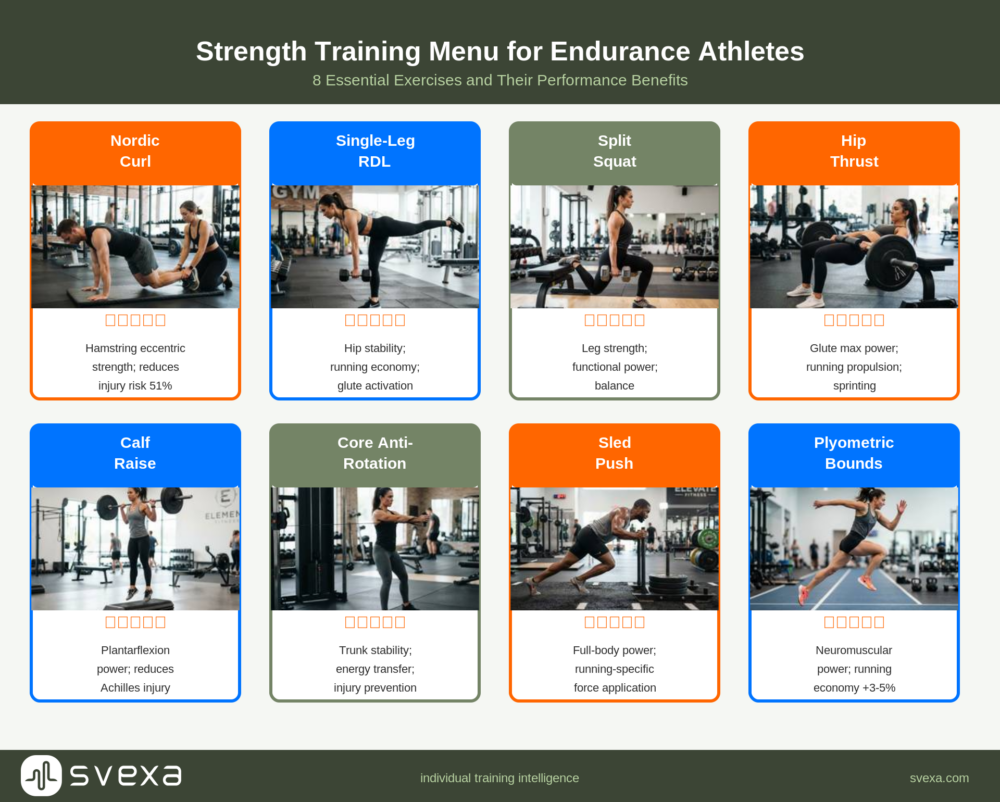
- Exercise selection matters: Exercises with high transfer to endurance performance include single-leg work (split squats, step-ups, single-leg RDL), hip hinge movements (Romanian deadlifts, hip thrusts), and calf/ankle strengthening (heavy calf raises, eccentric calf work for Achilles resilience).
- Avoid muscular hypertrophy training: Traditional bodybuilding protocols (3 sets of 10–12 reps at moderate loads) are the least appropriate approach for endurance athletes. They increase muscle mass without the neuromuscular adaptations that drive performance improvement, creating an unfavorable mass:strength ratio.
Programming Strength Training Around Endurance Training
Integrating strength training effectively requires attention to sequencing and recovery (see our guide to concurrent training). Practical recommendations:
- Perform strength sessions 2–3 times per week during base and build phases, reducing to 1–2 sessions in peak and taper phases.
- Schedule strength sessions before high-intensity endurance sessions or on easy days, not before long runs or time trials.
- Begin with 8–10 week strength development blocks before testing performance benefits; short intervention periods often underestimate adaptation potential.
- Maintain a minimum of 2 strength sessions per week year-round to preserve neuromuscular adaptations during race-focused periods.
Svexa’s IRMA platform provides combined training recommendations for strength and endurance, or any other combination of sports. It uses svexa’s proprietary algorithm to track integrated neuromuscular load from strength sessions alongside cardiovascular training load, giving a complete picture of total athlete stress. Contact Us to explore more.