The Rise of the Hybrid Athlete
The endurance-only or strength-only athlete is increasingly rare. Whether you are training for the HYROX fitness racing format that combines eight functional strength stations with eight 1-kilometer runs, preparing for a multi-sport competition, or simply trying to be strong and fit simultaneously, you face the central challenge of concurrent training: how to develop both strength and endurance without each one undermining the other. Exercise science calls this the “interference effect”, the phenomenon where adaptations to strength training and endurance training partially conflict at the molecular level. Understanding this mechanism is the key to training smarter around it.
The Interference Effect: What the Science Shows
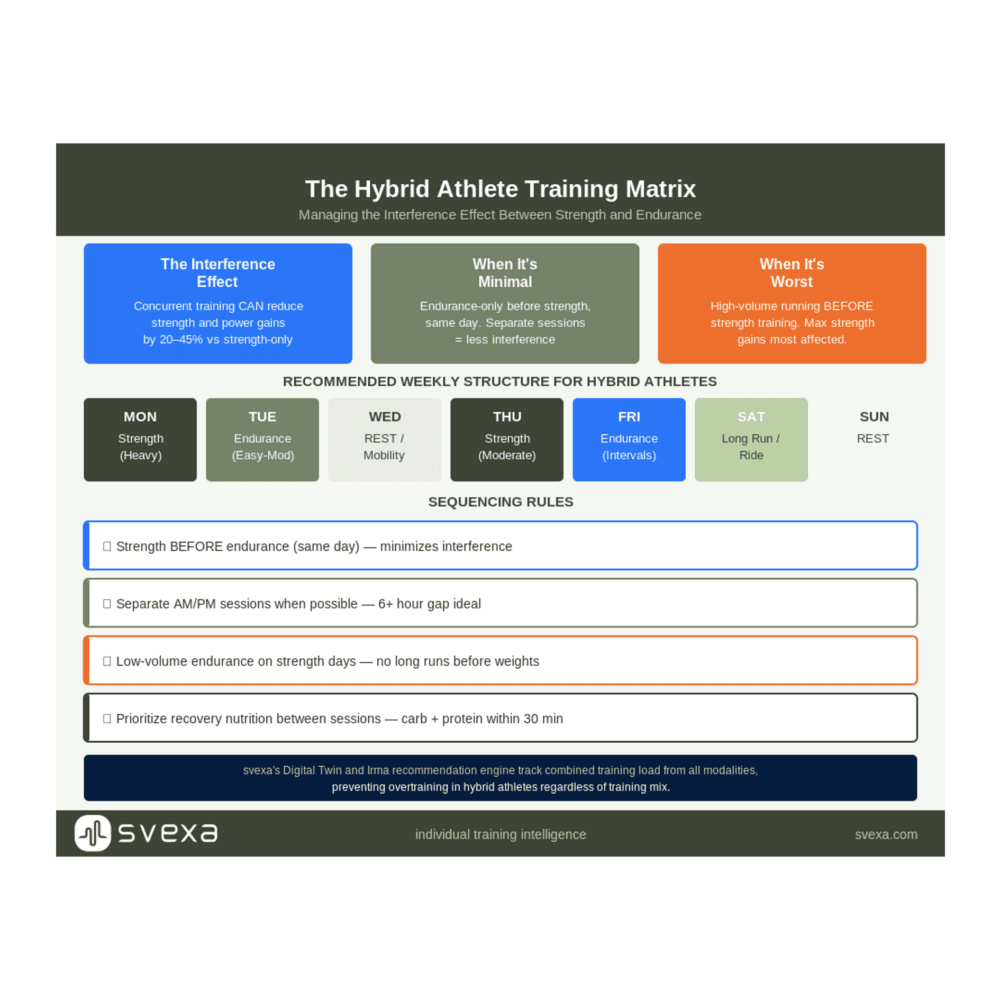
The interference effect was first documented systematically by Hickson (1980), who showed that athletes performing concurrent strength and endurance training saw smaller strength gains than those performing strength training alone. The molecular explanation, developed over subsequent decades, centers on competing signaling pathways: Endurance training activates AMPK (adenosine monophosphate-activated protein kinase), a metabolic energy sensor that promotes mitochondrial biogenesis and aerobic adaptation. Strength training activates mTOR (mechanistic target of rapamycin), which drives muscle protein synthesis and hypertrophy. The critical finding is that AMPK inhibits mTOR, meaning that endurance work performed in close temporal proximity to strength training can blunt the strength adaptation response. However, and this is important: the interference effect is far less severe for endurance adaptations. Adding strength training to an endurance program typically does not impair VO2max development, threshold power, or running economy. In fact, strength training consistently improves running economy by 3–8% and cycling efficiency in trained endurance athletes, a powerful performance benefit achieved without compromising aerobic capacity.
Practical Strategies to Minimize Interference
Research over the past two decades has identified several evidence-based strategies that significantly reduce the interference effect:
- Session sequencing: Perform strength training before endurance work in the same day wherever possible. AMPK activation from endurance exercise lasts 3–6 hours; completing strength work before this window starts preserves mTOR signaling.
- Separate sessions: When training twice daily, separate strength and endurance sessions by at least 6 hours. Morning strength + afternoon endurance is a well-supported schedule for high-volume athletes.
- Fuel status: Endurance training performed in a low-carbohydrate state (fasted morning sessions) amplifies AMPK activation. If your goal is strength retention, avoid strength sessions immediately after glycogen-depleting endurance work.
- Strength training modality: Heavy, low-repetition strength work (3–5 reps at 80–90% 1RM) provokes less AMPK activation than moderate-load, high-repetition work, reducing interference with subsequent endurance adaptations.
- Periodization: Structure training blocks to emphasize one quality at a time. A strength block followed by an endurance build is more effective than trying to maximize both simultaneously throughout the year.

The HYROX-Specific Case
HYROX presents a unique training challenge because the race itself is concurrent – you run between functional strength stations, meaning aerobic capacity and muscular endurance must perform simultaneously. This argues for training specificity: as race day approaches, training should increasingly replicate this combination, even if earlier blocks developed strength and endurance in more isolated fashion. The most effective HYROX preparation programs use a progressive concurrent training model, beginning with separate strength and run sessions in the base phase, introducing combined sessions in the build phase, and emphasizing race-specific simulation (continuous run-exercise-run circuits) in the final 6–8 weeks.
Monitoring the Hybrid Athlete
Hybrid athletes face a more complex monitoring challenge than those training a single quality. Neuromuscular fatigue from strength work is distinct from cardiovascular fatigue from endurance work, yet both compete for the same recovery resources. Heart Rate Variability tracking provides a useful integrated signal by capturing the combined autonomic burden of all training stressors, while session RPE (Rate of Perceived Effort) helps distinguish which component is causing most fatigue on a given day.
Svexa’s Digital Twin continually integrates HRV, sleep, and session load data across all training modalities, so we always have an accurate ‘full body’ profile of each athlete’s physiology. Building on this foundation, our Irma recommendation engine can deliver personalized training plans for strength, endurance, multisport like triathlon, or hybrid training of whichever disciplines the athlete chooses.