The Case for Structure
The free ride. The “go by feel” run. The open water swim with no pace target. Every serious athlete knows the pleasure of unstructured training – moving without a plan, responding to how you feel, letting your body lead. And for recovery sessions, active rest days, and psychological renewal, this approach has genuine merit. But for the majority of your training, especially as you approach competition, structure delivers measurably better outcomes. The evidence is not subtle. A landmark 2015 meta-analysis by Laursen & Jenkins in Sports Medicine reviewed 37 studies on high-intensity interval training (HIIT) protocols and found that structured interval work consistently outperformed unstructured “hard training” for VO2max gains, threshold improvement, and performance in competitive tests.
What “Structured” Really Means
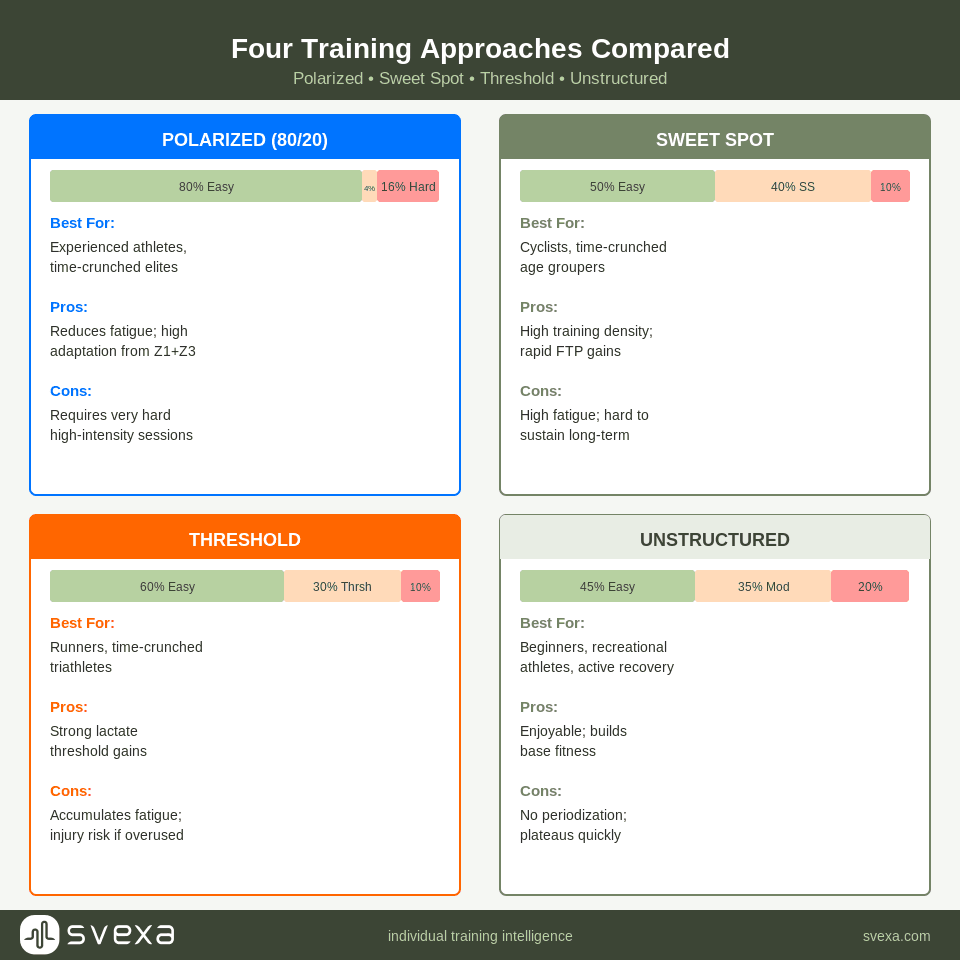
Structured training is not just putting numbers into a workout app. It means every session has a specific physiological target, a defined intensity, duration, and recovery prescription derived from your current fitness level, and a role within a larger periodized plan. Three major structured training philosophies have dominated endurance coaching debates:
- Polarized training (80/20): Pioneered by Stephen Seiler through research on elite cross-country skiers, rowers, and cyclists, the polarized model prescribes approximately 80% of training volume at low intensity (below the first ventilatory threshold) and 20% at high intensity (above the second ventilatory threshold). The key insight: almost nothing should be done at “moderate” intensity, which Seiler identifies as the zone that is simultaneously too hard to permit full recovery and too easy to drive significant adaptation.
- Sweet spot training: Popularized in cycling, sweet spot targets 88–93% of FTP, the intensity range where the power:recovery ratio is most favorable for threshold development. Advocates argue it builds threshold fitness faster than polarized training’s low-intensity base work. Critics note it produces higher cumulative fatigue and is harder to sustain across long training blocks without overreaching.
- Threshold training: Traditional lactate threshold training prescribes a significant proportion of work at or near FTP. Research supports its effectiveness for threshold improvement, but its high recovery cost makes it unsuitable as the dominant training method for all but the most experienced athletes.
What the Evidence Actually Favors
A rigorous 2019 study by Stoggl & Sperlich in Frontiers in Physiology directly compared polarized, threshold, high-intensity, and pyramidal training models across trained endurance athletes. The polarized group showed the greatest improvements in VO2max (+11.7%), time to exhaustion (+17.4%), and performance metrics, while reporting the lowest perceived training stress. This finding has been replicated across multiple disciplines and athlete populations. The consistent pattern: polarized distribution i.e. plenty of easy, some hard, very little moderate outperforms approaches that spend more time at moderate intensity, particularly for athletes with sufficient volume to accumulate meaningful low-intensity work. The caveat: these studies typically examine trained athletes over 6–12 weeks. For recreational athletes with limited training time (fewer than 8 hours per week), sweet spot or threshold work may deliver proportionally greater fitness gains per hour invested than base-heavy polarized training.
When Unstructured Training Has a Role
Structure is not universally superior. Research on motivational psychology in sport consistently shows that rigid structure can undermine intrinsic motivation, particularly for recreational athletes and those early in their training career. Perceived autonomy is a significant predictor of long-term training adherence, and an athlete who abandons a perfectly designed plan after six weeks achieves nothing. The practical model most coaches and researchers recommend is structured sessions for the high-quality work (intervals, tempo, long endurance efforts) combined with genuinely unstructured easy sessions. Easy days should be easy by design, not by accident. Removing intensity targets from recovery runs and walks prevents athletes from unconsciously drifting into moderate-intensity zones that compromise recovery.
Svexa and Intensity Distribution
Svexa’s Digital Twin tracks intensity distribution automatically from power and heart rate data, surfacing whether your training is actually polarized or accumulating in the moderate zone without your awareness. Then our IRMA recommendation engine visualizes your intensity distribution across any time period and compares it to evidence-based targets for your current training phase. Contact Us any time to discuss how svexa’s training plans can help you athletes achieve the right sort of training structure for their personal needs.