The Problem with Every Plan You’ve Ever Downloaded
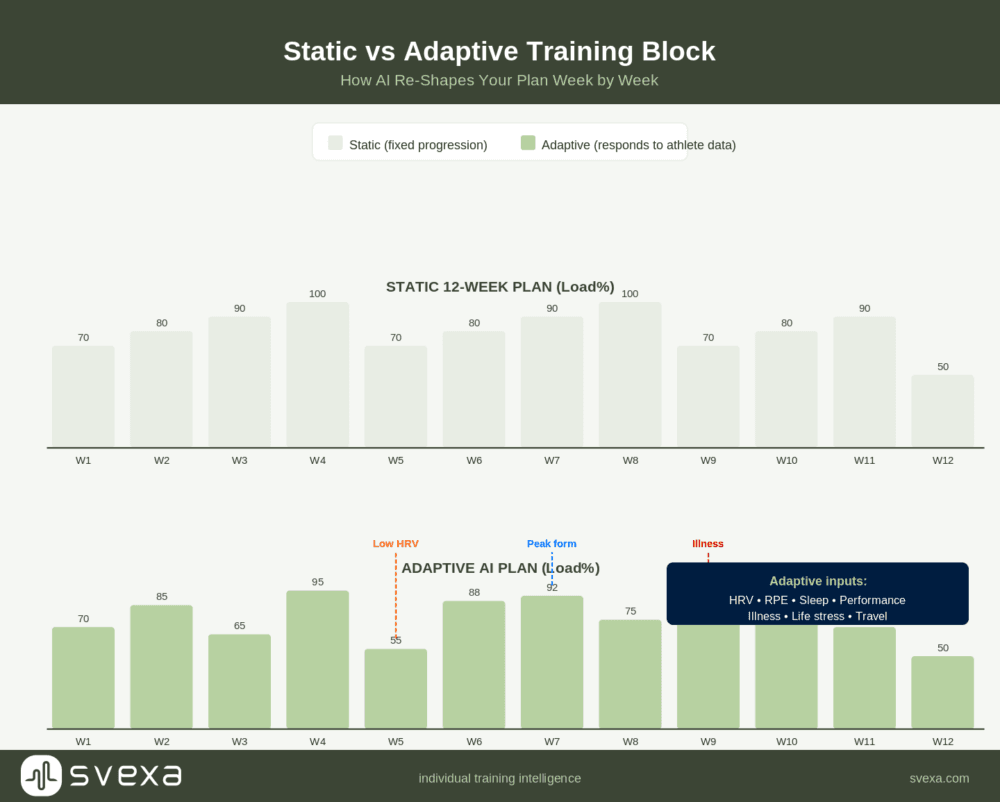
The 16-week marathon plan. The 12-week cycling build. The triathlon training block your coach emailed you at the start of the year. These plans share something important: they were written for an athlete who does not exist. Static training plans are built on averages: average recovery rates, average adaptation responses, average life stress. They assume that week 8 for you will look the same physiologically as week 8 looked for every other athlete who ever ran that plan. They cannot know that you slept four hours on Tuesday because your infant was sick, that a work deadline suppressed your training motivation for three days, or that your body responded unusually well to last month’s long run block and is ready for more. The result is a system that is chronically either too easy or too hard, rarely exactly right, and that becomes less accurate the further you progress through the block, as accumulated deviations from the plan compound.
What Makes a Training Plan “Adaptive”?
True adaptive training is not simply a plan that your coach adjusts at the weekly check-in. It is a system that continuously monitors your physiological state and modifies your training prescription in real time based on evidence of how you are actually responding.
The inputs that drive a genuinely adaptive system can include:
- HRV (Heart Rate Variability): The most sensitive non-invasive marker of autonomic nervous system recovery. A suppressed HRV trend signals accumulated physiological stress and predicts reduced adaptation to high-intensity training.
- Resting Heart Rate: An elevated resting HR relative to individual baseline indicates incomplete recovery and heightened cardiovascular strain.
- Session RPE (Rating of Perceived Exertion): How hard did each session actually feel? A session that felt significantly harder than planned at equivalent power or pace is a signal the athlete is working at a higher physiological cost.
- Sleep metrics: Quantity and quality. Chronic sleep restriction impairs glycogen resynthesis, protein synthesis, and neuromuscular function – all the processes that drive training adaptation.
- Performance data: Power output, pace, lactate values, or any objective performance marker that reveals whether adaptation is occurring as expected.
An adaptive system integrates all of these signals into a real-time model of the athlete’s current physiological state and adjusts the prescribed training accordingly. It increases load when adaptation is progressing well, reduces it when recovery is incomplete, and modifies intensity distribution when the athlete’s fatigue profile shifts.

The Science Behind Why This Works Better
Exercise science has known for decades that individual responses to training stimuli vary enormously. Two athletes performing identical training blocks can show adaptations ranging from minimal improvement to substantial performance gains, driven by genetic differences in training responsiveness, hormonal profiles, muscle fiber composition, and sleep quality.
A landmark 2019 paper in the Journal of Physiology by Pitsiladis et al. documented extraordinary inter-individual variability in VO2max response to standardized aerobic training, with some subjects showing no response at all while others improved by more than 30%. Plews et al. (2017) in the International Journal of Sports Physiology and Performance also demonstrated superior adaptations from individually prescribed versus group-based training. And in svexa’s 2023 study, CSO Filip Larsen and colleagues have demonstrated that athletes who follow an adaptive training plan achieve better outcomes than those following an individualized but ‘static’ plan.This variability between athletes is not noise, it is signal. It reflects genuine biological differences that static plans cannot accommodate. Adaptive training plans are more effective precisely because they treat this variability as the fundamental design constraint. Rather than assuming all athletes respond identically, they learn each athlete’s individual response pattern and use it to continuously calibrate load.
What Adaptive Training Looks Like Day-to-Day
A well-designed adaptive training system does not just send you easier workouts when you are tired. It makes principled, evidence-based decisions across multiple dimensions:
- Load volume: Weekly training load (measured in TSS, hours, or distance) adjusts dynamically based on measures such as your acute:chronic workload ratio, preventing both overreaching and under-stimulus.
- Intensity distribution: The ratio of easy/moderate/hard training shifts based on your fatigue state. When HRV is suppressed, high-intensity intervals are deprioritized in favor of aerobic base work that builds fitness with lower recovery cost.
- Session structure: Individual workout targets update based on current fitness estimates. If your Critical Power or FTP has improved since the plan was written, the system recalibrates workout targets upward.
- Recovery timing: Rest days and easy recovery sessions are inserted when physiological signals indicate they are needed, not just when the calendar says it’s a rest day.
Svexa’s Approach to Adaptive Individual Training
Svexa’s entire ethos is built on the principle that every athlete’s physiology is unique and that training plans should adapt to the athlete, not the other way around. Our platform continuously ingests HRV, sleep, session data, subjective wellness scores and other available data to build and maintain an individualized physiological model for each athlete, their Digital Twin.
This model first drives a daily readiness indicator presented through our Readiness Advisor, which synthesizes all incoming data into a single daily readiness score and training direction. Our IRMA integrated platform and other algorithms then mesh this readiness with planned training to deliver an updated, adaptive recommendation.