GPS Has Transformed Soccer Analysis. But Are You Using It Right?
GPS tracking has become ubiquitous in professional soccer (and in many other pro sports) over the past decade. From the Premier League, MLS or Serie A to lower divisions worldwide, virtually every professional club now collects GPS data from training and matches. This generates an enormous volume of position, speed, acceleration, and distance data for every player, every session. The adoption of GPS technology has been near-universal. However, the sophisticated use of that data remains far from universal. The most common failure mode in GPS analytics is what practitioners sometimes call “data reporting without data insight”: producing weekly load reports that describe what happened, without connecting that description to decisions that change training, reduce injury risk, or improve performance. This guide is a practical resource for coaches, analysts, and performance staff who want to move from reporting GPS metrics to using them effectively.
Understanding the Core GPS Metrics
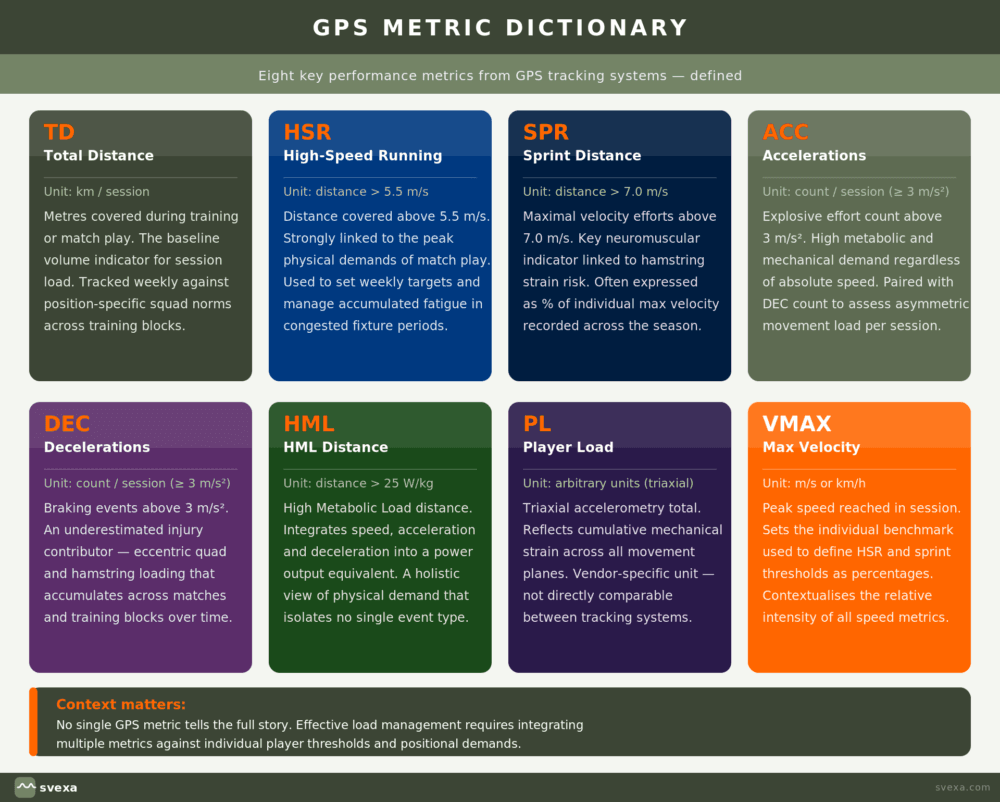
Total Distance
Total distance covered is the most basic external load metric and the longest-standing. In soccer, positional norms are well-established: central midfielders and wide midfielders typically cover 10–12 km per match, while central defenders and strikers cover 9–10 km. Total distance is useful as a workload indicator, but is relatively coarse – a 10 km session at mostly jogging pace is very different physiologically from a 10 km session with multiple sprint efforts and rapid directional changes.
High-Speed Running (HSR) and Sprint Distance
High-speed running (typically defined as speeds above 5.5 m/s, approximately 19.8 km/h) and sprint distance (above 7 m/s, approximately 25.2 km/h) are more sensitive indicators of physical demand than total distance, capturing the efforts most strongly associated with match physical performance and injury risk. Research consistently demonstrates that match-day HSR is one of the strongest external load predictors of post-match fatigue and recovery time requirements.
Acceleration and Deceleration Counts
Accelerations and decelerations above 3 m/s² are increasingly recognized as the most physiologically demanding elements of team sport activity, generating disproportionate muscular stress relative to their distance contribution. Studies using biochemical markers have shown that high acceleration/deceleration counts are more strongly correlated with muscle damage (elevated CK) than total or high-speed running distance. This makes acc/dec counts particularly relevant for injury risk monitoring and load management in congested fixture periods.
PlayerLoad and Derived Metrics
PlayerLoad, a proprietary metric originally developed by Catapult from triaxial accelerometer data, integrates the magnitude of change-of-direction, acceleration, and deceleration forces across a session into a single cumulative value. It is useful for capturing the physical cost of training that does not generate significant GPS distance – heavy contact drills, possession work on small pitches, and strength and conditioning sessions.
Position-Specific Analysis: Context Is Everything
GPS data only becomes truly actionable when it is interpreted relative to positional norms and individual baselines. A central defender covering 9.8 km in a match is performing within normal parameters; a central midfielder covering the same distance is significantly underperforming their positional average. Absolute values without position-specific context lead to incorrect conclusions. Individual baselines matter even more than positional norms. The same GPS outputs from two players of the same position represent very different physiological costs if one is at the beginning of a heavy training week and the other is the day after a rest day. Contextualising GPS within the individual’s load history is the essential analytical step that transforms raw data into insight.
Common GPS Data Mistakes to Avoid
- Treating team average loads as meaningful: population averages mask the high-load and low-load outliers who most need attention
- Ignoring the acc/dec story: focusing only on distance metrics underestimates the true physical cost of match-like training
- Comparing absolute values without positional context: position-specific benchmarks are essential
- Using GPS alone without internal load complement: external load without physiological response context is incomplete
- Producing load reports without decision outputs: every GPS report should identify at least one actionable finding or decision trigger
Zone7 by svexa integrates GPS data other available sources to build a unique Digital Twin of each player, then simulates planned upcoming training and match load to predict risk levels. It flags players at higher injury risk, and allows the team staff to simulate changes to training so they can best plan how each player should train. Contact Us to explore Zone7’s capabilities and how svexa’s IRMA platform connects GPS data with the full athlete monitoring picture.