
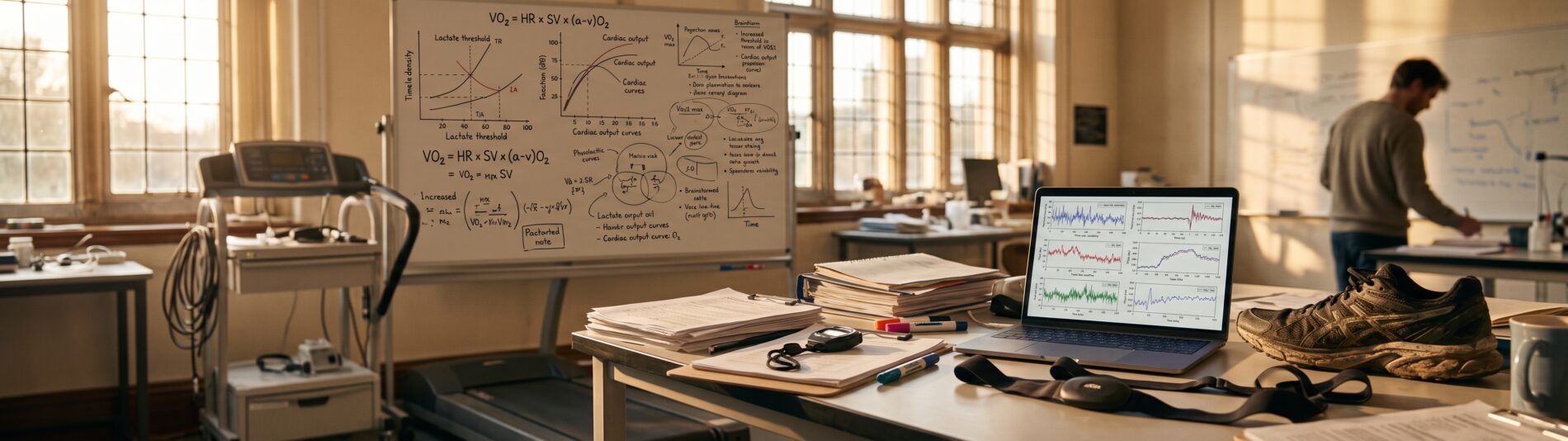
Science first since long before svexa
Svexa’s founders have worked together for nearly two decades in exercise physiology, precision medicine, genetics and data science, at Karolinska Institute and Stanford University, with over a hundred years of combined experience. The individualized, longitudinal approach behind every svexa product comes straight from those years of sports science and publications.
~20 years
shared research history
of svexa’s founders
of svexa’s founders
100+
years of
combined experience
combined experience
50,000+
participants in MyHeart Counts,
co-led by svexa founders
co-led by svexa founders
2018
svexa founded, after
a Premier League pilot
a Premier League pilot
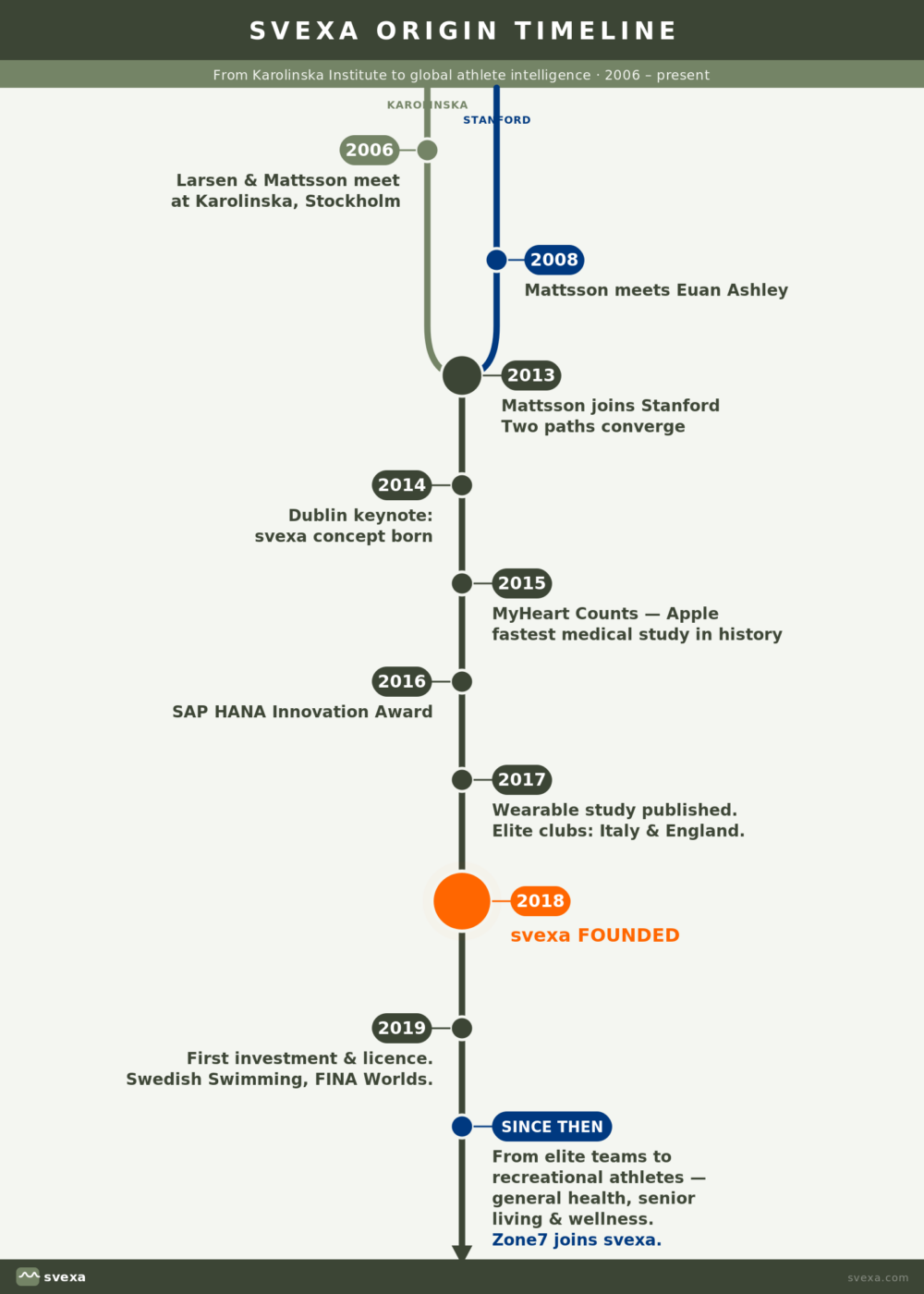
From the lab to the pitch – our story
- 2006:Filip Larsen and Mikael Mattsson meet at Karolinska Institute, Stockholm, starting PhDs in the same physiology and pharmacology department.
- 2008: Mattsson first meets Euan Ashley.
- 2013: Mattsson moves his research to Stanford University to work with Ashley.
- 2014: Daryl Waggott joins the Stanford group. At a sports-science conference keynote in Dublin, a Premier League Head of Performance describes manually aggregating eleven data sources to plan each player’s next-day training, sparking the idea for svexa.
- 2015: MyHeart Counts launches with Apple’s ResearchKit, becoming the fastest-recruiting medical study in history.
- 2016: The Stanford team wins the SAP HANA Innovation Award for a precision health platform.
- 2017: Landmark Stanford wearable-accuracy study published. Two of Europe’s leading football clubs, from Italy and England, approach the group.
- 2018: A pilot with a Premier League club produces individualized injury-risk and training-optimization profiles, and svexa is founded.
- 2019: First institutional investment and first commercial license (Activio). Work with the Swedish Swimming national team ahead of the FINA World Championships.
- Since then: elite teams in multiple sports, then recreational athletes, and now general-population health, senior living and wellness. Zone7 joins svexa.

THE FOUNDERS: Euan Ashley, MD, PhD
Chair of the Department of Medicine at Stanford University and Professor of Medicine, Genetics and Biomedical Data Science. Recipient of the NIH New Innovator Award and the American Heart Association National Innovation Award; recognized by the Obama White House for contributions to personalized medicine and worked on the Precision Medicine Initiative (All of Us). Author of The Genome Odyssey, Non-Executive Director of AstraZeneca and Dexcom, and founder of Nasdaq-listed Personalis. Svexa is his third company.
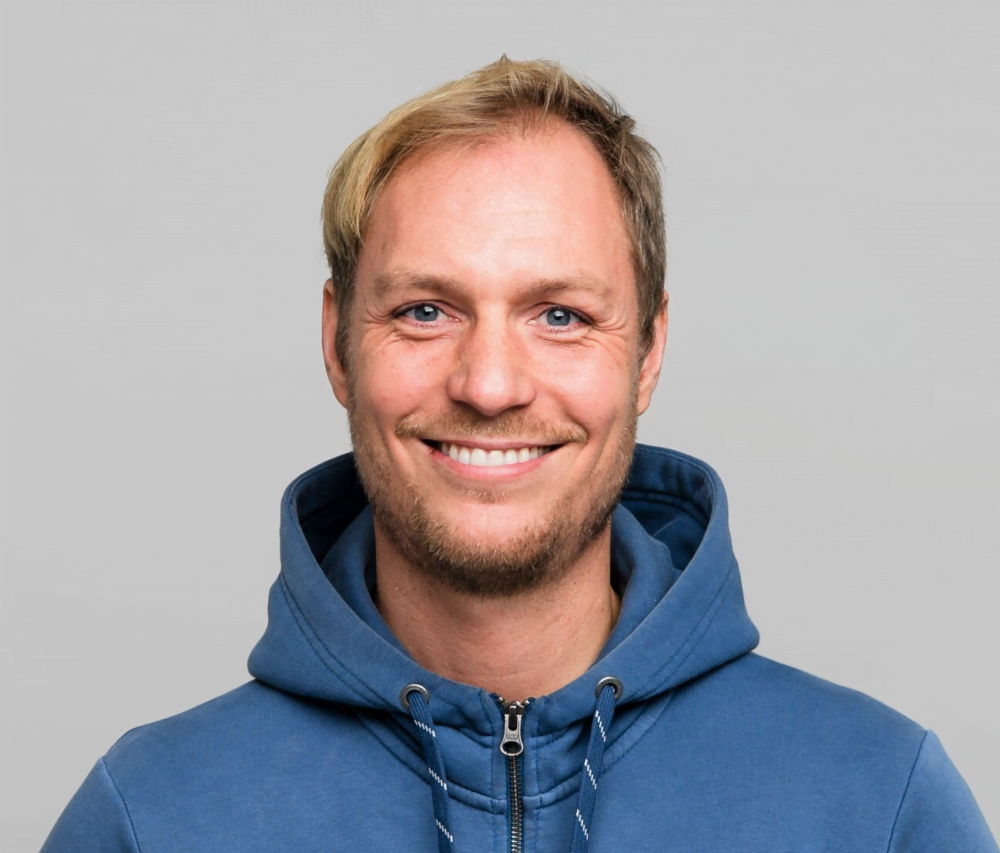
THE FOUNDERS: C. Mikael Mattsson, PhD
Exercise physiologist with around 30 years of experience training elite athletes. Co-author of Swedish training textbooks on heart-rate training, aerobic fitness and training planning used in Swedish Sports Federation coach education. Senior Researcher at Stanford University in wearables, precision and mobile health, and an ultra-endurance runner.
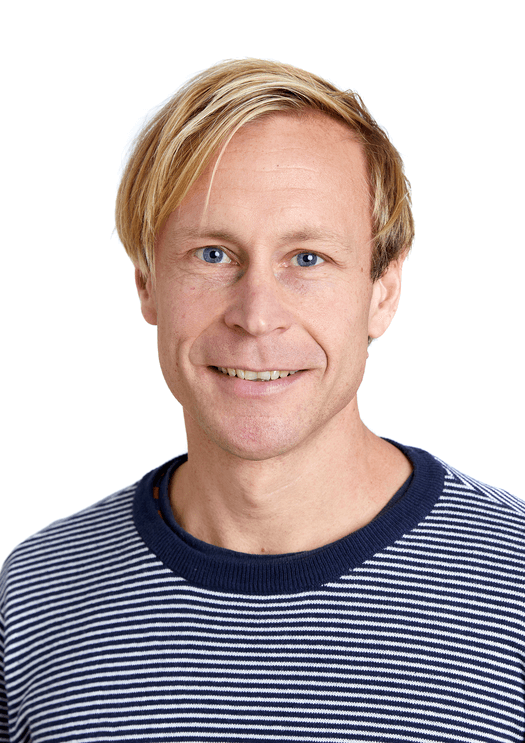
THE FOUNDERS: Filip Larsen, PhD
Associate Professor in Sports and Health Science, working across exercise physiology, metabolic health and precision health. Performance advisor to several national teams, co-author of training textbooks, competitive cyclist and runner. Leads many research studies for svexa and the Karolinska Institutet.

THE FOUNDERS: Daryl Waggott, MSc
Quantitative geneticist and former Senior Research & Data Scientist at Stanford, focused on genomics, wearable data and digital health; advises biomedical companies on becoming AI-ready. Former Director at Genome Canada. His sports-genetics research with Ashley and Mattsson showed genetic tests are not a reliable predictor of athletic talent, which is why svexa favors physiological, data-driven individualization.
Foundational Research
- MyHeart Counts (2015 onward)
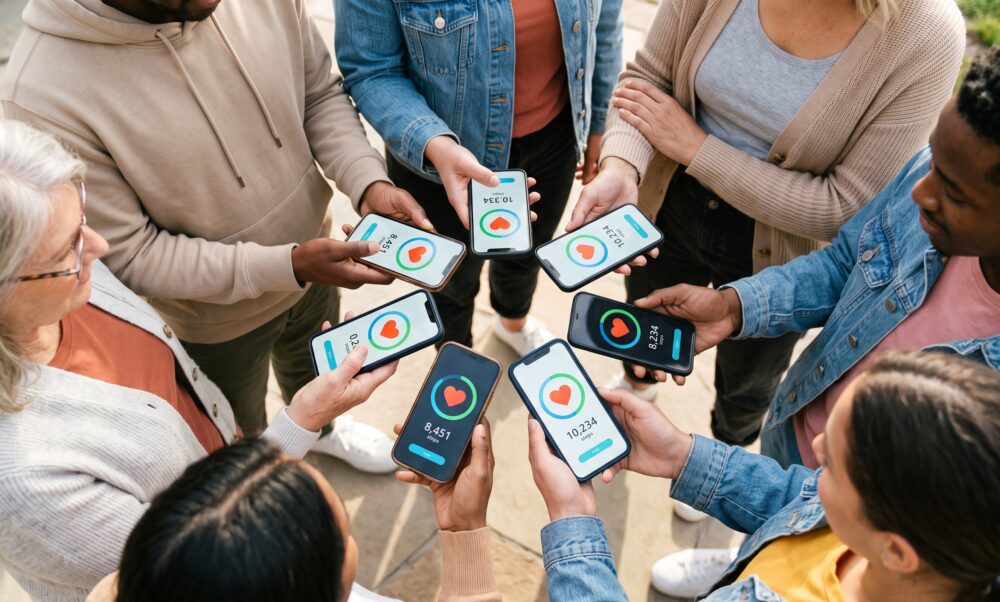
Launched by Stanford Medicine with Apple’s ResearchKit, this smartphone-based study collected activity, fitness tests (including six-minute walk tests) and health surveys from more than 50,000 participants, the fastest-recruiting medical study in history. It continues to publish findings on activity, sleep and cardiovascular health. - SAP HANA Innovation Award (2016)
Recognized a Stanford precision-health platform, engineered by Daryl Waggott, that integrated genomic sequencing with real-time wearable data in electronic health records, cutting complex genomic analysis from months to days. - Wearable accuracy study (2017)
Seven leading wrist-worn devices tested against clinical gold standards (ECG and indirect calorimetry) in 60 diverse participants. Heart rate was mostly acceptable; every device failed on energy expenditure, with errors above 20%. This finding still shapes svexa’s individualized correction methods.

A team with dual competence
Beyond the founders, svexa recruits for “dual competence”: scientific or engineering degrees plus personal experience of human performance at the highest level. Our team includes Olympians, national champions, a world champion adventure racer and national-team coaches who are also physicists, engineers and data scientists. They know what athletes need, and where traditional systems fall short.
Selected Publications
Training & performance
- Nilsson LC, Södergård O, Rogestedt J, Mattsson CM, Larsen FJ. Transforming the performance of runners with AI-driven training planning and daily adaptivity. bioRxiv 2023. doi:10.1101/2023.10.06.561160
- Eriksson R, Nicander J, Johansson M, Mattsson CM. Generating weekly training plans in the style of a professional swimming coach using genetic algorithms and random trees. PACSS 2021:61–68. doi:10.1007/978-3-030-99333-7_9
- Spetz L, Rogestedt J, Nilsson R, Mattsson CM, Larsen FJ. Validating subjective ratings with wearable data for a nuanced understanding of load-recovery status in elite endurance athletes. Sports Med Open 2025;11(1):154. doi:10.1186/s40798-025-00958-y
- Zinner C, Morales-Alamo D, Ørtenblad N, Larsen FJ, et al. The physiological mechanisms of performance enhancement with sprint interval training differ between the upper and lower extremities in humans. Front Physiol 2016;7:426. doi:10.3389/fphys.2016.00426
Overtraining & metabolism
- Flockhart M, Nilsson LC, Tais S, Ekblom B, Apró W, Larsen FJ. Excessive exercise training causes mitochondrial functional impairment and decreases glucose tolerance in healthy volunteers. Cell Metab 2021;33(5):957–970. doi:10.1016/j.cmet.2021.02.017
- Flockhart M, Nilsson LC, Ekblom B, Larsen FJ. A simple model for diagnosis of maladaptations to exercise training. Sports Med Open 2022;8(1):136. doi:10.1186/s40798-022-00523-x
- Flockhart M, Larsen FJ. Continuous glucose monitoring in endurance athletes. Sports Med 2024;54(2):247–255. doi:10.1007/s40279-023-01910-4
- Larsen FJ. Lactate-driven mitochondrial pretenders hijack hippocampal function after excessive exercise. Cell Metab 2026;38(2):257–259. doi:10.1016/j.cmet.2026.01.003
- Nilsson A, Björnson E, Flockhart M, Larsen FJ, Nielsen J. Complex I is bypassed during high intensity exercise. Nat Commun 2019;10(1):5072. doi:10.1038/s41467-019-12934-8
Wearables & digital health
- Shcherbina A, Mattsson CM, Waggott D, et al., Ashley EA. Accuracy in wrist-worn, sensor-based measurements of heart rate and energy expenditure in a diverse cohort. J Pers Med 2017;7(2):3. doi:10.3390/jpm7020003
- Hershman SG, et al., Waggott D, et al., Ashley EA. Physical activity, sleep and cardiovascular health data for 50,000 individuals from the MyHeart Counts Study. Sci Data 2019;6(1):24. doi:10.1038/s41597-019-0016-7
- Shcherbina A, et al., Waggott D, et al., Ashley EA. The effect of digital physical activity interventions on daily step count: a randomised controlled crossover substudy of the MyHeart Counts Cardiovascular Health Study. Lancet Digit Health 2019;1(7):e344–e352. doi:10.1016/S2589-7500(19)30129-3
- Javed A, et al., Mattsson CM, et al., Ashley EA. Personalized digital behaviour interventions increase short-term physical activity. Eur Heart J Digit Health 2023;4(5):411–419. doi:10.1093/ehjdh/ztad047
- Johnson A, Hershman SG, Javed A, Mattsson CM, et al., Ashley EA. Mobile health study incorporating novel fitness test. J Cardiovasc Transl Res 2023;16(3):569–580. doi:10.1007/s12265-022-10317-x
- Kim DS, et al., Mattsson CM, et al., Ashley EA. Unlocking insights: clinical associations from the largest 6-minute walk test collection via the MyHeart Counts Cardiovascular Health Study. Prog Cardiovasc Dis 2025;89:45–52. doi:10.1016/j.pcad.2025.01.010
Genetics & precision medicine
- Mattsson CM, Wheeler MT, Waggott D, Caleshu C, Ashley EA. Sports genetics moving forward: lessons learned from medical research. Physiol Genomics 2016;48(3):175–182. doi:10.1152/physiolgenomics.00109.2015
- Bouchard C, et al., Ashley EA, et al., Mattsson CM, et al. Personalized preventive medicine: genetics and the response to regular exercise in preventive interventions. Prog Cardiovasc Dis 2015;57(4):337–346. doi:10.1016/j.pcad.2014.08.005
FAQ
- Who founded svexa?
Svexa was founded in 2018 by Euan Ashley, C. Mikael Mattsson, Filip Larsen and Daryl Waggott, scientists from Stanford University and Karolinska Institute. - Is svexa’s technology based on published research?
Yes. Key evidence, including the overtraining detection, wearable-accuracy and sports-genetics research, and the testing protocols behind our validation data, was authored or co-authored by svexa’s founders and team.
Continue exploring svexa science
newsletter signup
Once in a while we send our subscribers a newsletter with corporate news, useful industry information or just a sneak peek of what we’re doing at svexa.