Why Training Zones Matter, and Why They’re Often Wrong
Training zones are the fundamental language of structured endurance training. Get them right and every session has a clear physiological purpose. Get them wrong and you spend weeks, sometimes months, accumulating junk miles that neither build aerobic base effectively nor develop top-end speed. The frustrating reality is that most athletes are training with imprecise zones built from imprecise tests, or no tests at all. Three major zone frameworks dominate endurance coaching: heart rate-based zones, FTP/threshold power zones, and the newer Critical Power three-domain model. Each has strengths, limitations, and appropriate applications. This guide explains how all three work and how to choose or combine them for maximum training precision. Many experts in the field have developed their own methodologies for using training zones, for example Dr Stephen Seiler’s research on polarized training and intensity distribution.
Heart Rate Zones: Simple, Accessible, and Often Misleading
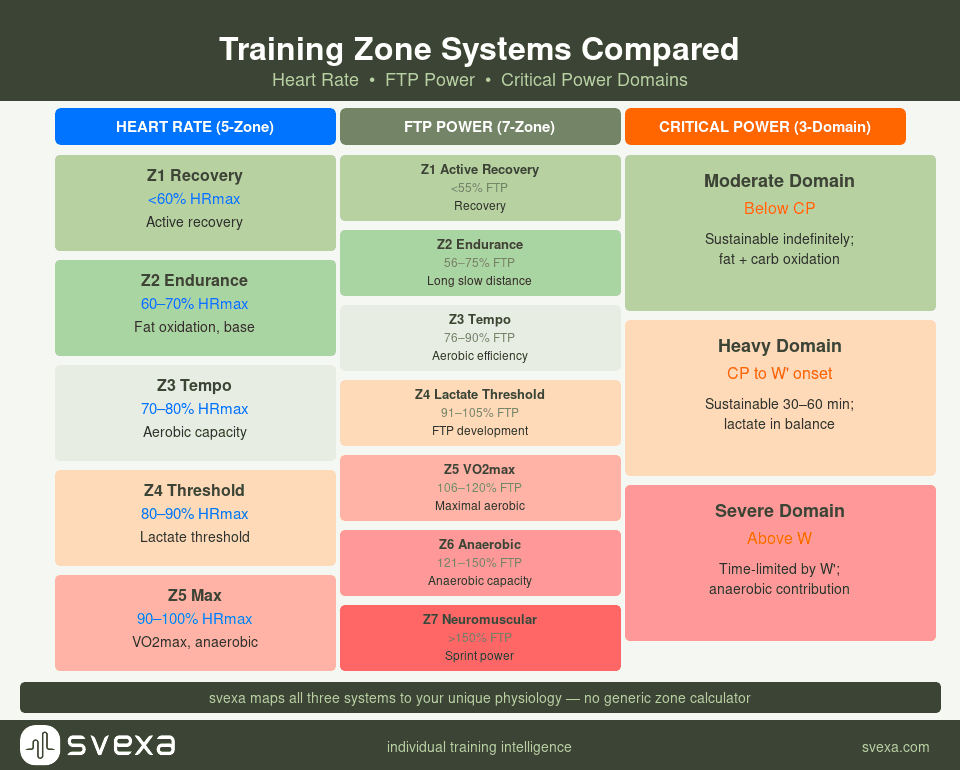
Heart rate training zones have been a fixture of endurance coaching since the 1980s. The most commonly used system divides effort into five zones relative to maximum heart rate (HRmax) or heart rate reserve (HRR), anchored at lactate threshold or ventilatory threshold. Zone 1 is easy aerobic; Zone 5 is maximal effort; Zones 2–4 represent progressive intensities through threshold and above. The appeal is obvious: heart rate monitors are inexpensive, wearable all day, and provide continuous feedback. The problem is that heart rate is a lagging indicator of effort i.e. it takes 60–90 seconds to reflect a change in power output or pace, and is highly sensitive to environmental conditions, hydration status, caffeine, altitude, heat, and emotional state. The same power output at the same fitness level can produce heart rates 10–15 bpm apart on a hot day versus a cold one. Heart rate zones also rely on accurate knowledge of HRmax, which many athletes still estimate using the flawed “220 minus age” formula. Research has shown the standard deviation around that formula is approximately ±11 bpm, meaning roughly 30% of athletes using it have zones that are systematically too high or too low.
FTP-Based Power Zones: More Precise, But Still a Single Point
Power-based training zones, anchored to Functional Threshold Power (FTP), largely solved the noise problem of heart rate training. Power is an instantaneous, objective measure of work rate unaffected by weather, caffeine, or anxiety. The seven-zone system pioneered by Dr. Andrew Coggan divides training from active recovery (Zone 1) through neuromuscular power (Zone 7), with Zones 3–5 representing the threshold band. Power zones provide excellent day-to-day consistency and are the standard for competitive cyclists and triathletes. However, FTP zones share the limitation of any single-threshold system: they tell you what you can sustain for roughly an hour but nothing about your performance at shorter durations, your rate of fatigue above threshold, or how your capacity evolves over the course of a hard session.
The Critical Power Three-Domain Model: Physiology-First Zoning
Exercise physiologists have increasingly adopted a three-domain intensity framework built on Critical Power (CP):
- Moderate domain: Below CP. Physiologically steady-state exercise that can theoretically be sustained indefinitely (limited only by fuel). This is where base aerobic development occurs. Corresponds roughly to Zone 1–2 in most systems.
- Heavy domain: Above the first ventilatory threshold but below CP. Lactate is elevated but stable. Sustainable for extended durations (30–90 minutes). Drives significant aerobic adaptation but with meaningful recovery cost.
- Severe domain: Above CP. VO2max is reached, W’ (anaerobic reserve) depletes continuously. Effort duration is mathematically predictable from CP and W’. This is where VO2max intervals and race-pace work live.
The practical implication is significant: the boundary between heavy and severe intensity is not at FTP or lactate threshold, instead it is at Critical Power which is typically 5–15% higher than FTP for trained athletes. Prescribing “threshold” intervals at FTP means you may actually be working in the heavy domain rather than the severe domain, achieving different adaptations than intended.

How to Determine Your Zones Accurately
For most athletes, the most practical approach combines elements of all three frameworks:
- Test Critical Power: Perform 3–5 maximal efforts at different durations (typically 3, 8, 12, and 20 minutes) across separate days. Plot the power-duration curve to derive CP and W’.
- Calibrate heart rate to power zones: Once you have power zones, correlate them with heart rate data from steady efforts in each zone. This gives you a personalized heart rate:power relationship for when you are training without a power meter.
- Update regularly: CP, FTP, and heart rate zones all change with fitness. Retesting every 6–8 weeks ensures your zones remain accurate.
The good news is that svexa handles all of this! Our AI-driven training platform continuously analyses data gathered for each athlete by their wearables etc, recalculating their personalized thresholds and zones without formal testing.
Making Zones Work with svexa
Svexa’s individual performance platform supports all major zone frameworks and integrates power, heart rate, and physiological data into a unified training model. Critically, svexa does not use any simple formulae to calculate any of these zones. Instead, as mentioned above our AI calculates hyper-personalized zones using real observed training data from each athlete. We also use proprietary frameworks, for example including up to 7 Heart Rate zones for increased precision. All of these are part of the comprehensive Digital Twin we build for each person, as a foundation for all further analysis and recommendations for training or recovery. Our Irma training recommendation engine uses your specific zone calibration alongside daily readiness data (for example from our free app) to prescribe sessions that hit the intended training domain, not just a target number.