The Hamstring Problem Has Not Gone Away
Hamstring injuries are the single most common muscle injury in elite football, accounting for approximately 17% of all injuries and up to 4–5 injuries per club per season in top-flight leagues. Despite decades of research, improved warm-up protocols (most notably the Nordic Hamstring Exercise, whose adoption significantly reduces hamstring injury rates in controlled trials), and increasingly sophisticated monitoring, hamstring injury incidence in professional football has not substantially declined over the past 20 years. This stubbornness in the face of intervention has frustrated sports scientists and generated significant research interest. The emerging consensus is that hamstring injuries are not primarily explained by inadequate warm-up or poor flexibility, but instead they are explained by complex, time-dependent interactions between sprint load accumulation, fatigue, neuromuscular compensation patterns, and individual anatomy. Addressing these interactions requires tools that are simply more powerful than the human eye or simple spreadsheet monitoring.
Why Hamstrings Are Uniquely Vulnerable
The hamstring muscle group (biceps femoris, semimembranosus, semitendinosus) is particularly vulnerable to injury during maximal and near-maximal sprint efforts for several reasons. During the late swing phase of sprinting, the hamstrings must simultaneously lengthen under tension to decelerate the forward-swinging leg and generate force to initiate hip extension, a task that demands exceptional eccentric strength capacity and neuromuscular coordination. When the hamstrings are fatigued, or when sprint loads have accumulated faster than the tissue can adapt, this demand exceeds available capacity and strain injury occurs. Research in the
International Journal of Sports Physiology and Performance has shown that hamstring injuries cluster around specific phases of the season (pre-season and the period following international breaks) and specific match periods (late first half and late second half), strongly supporting the role of accumulated and transient fatigue in the injury mechanism.
The Multi-Variable Risk Landscape
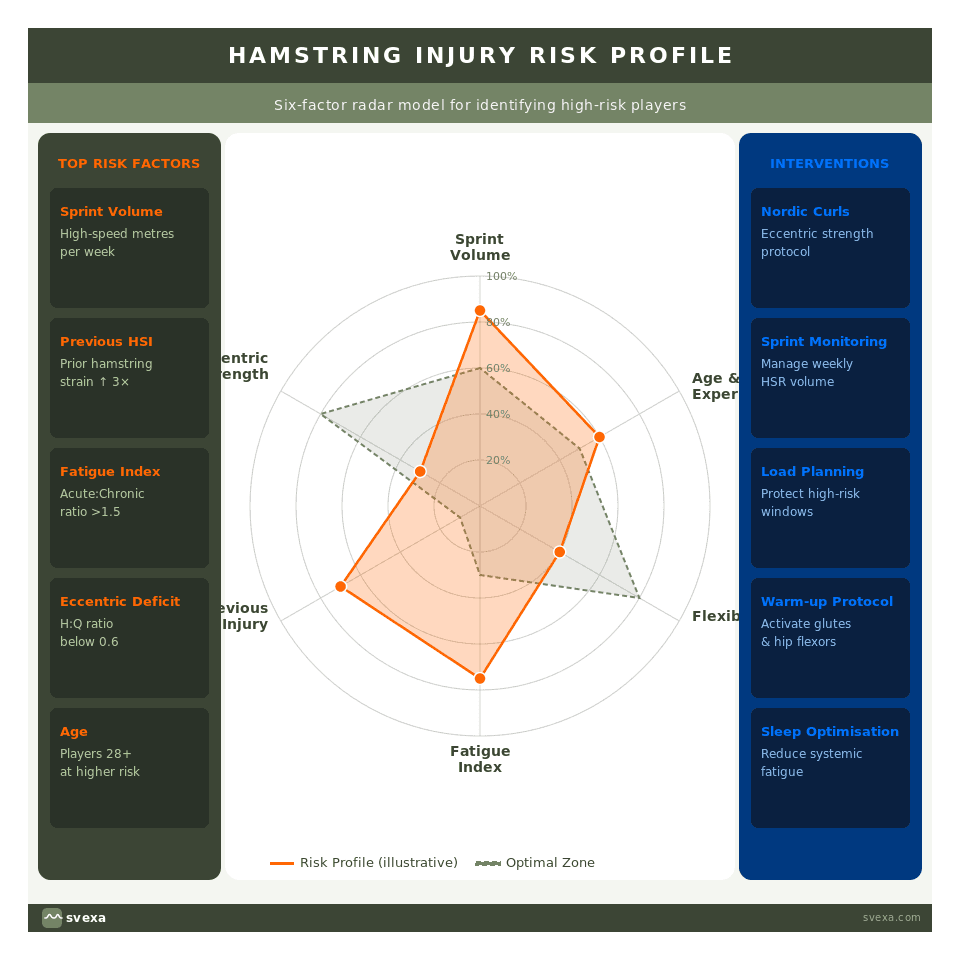
If hamstring injuries were driven by a single, easily measurable factor, they would have been solved by now. The challenge is that injury risk emerges from the convergence of multiple variables, each of which may be within acceptable limits individually while their combined effect exceeds tissue tolerance. Key variables that contribute to hamstring injury risk include:
- Previous hamstring injury (strongest single predictor – re-injury risk is 2–3x higher than initial injury)
- High sprint load in the preceding 7 days relative to chronic sprint baseline
- Acute:chronic workload ratio – sudden spikes in sprint volume after periods of relative rest
- Eccentric hamstring strength deficits (particularly bilateral asymmetry)
- Sleep debt and poor recovery metrics
- Late-game minutes in congested fixture periods
Detecting elevated risk from the combination of these factors, when any individual factor might not reach a clinical threshold, is precisely the problem that a well-trained AI is designed to solve.
Zone7’s AI Approach to Hamstring Injury Prediction
Zone7 by svexa’s predictive models are trained on large longitudinal datasets of professional athletes, incorporating GPS sprint data, training load history, match minutes, previous injury records, recovery metrics, and wellness scores. The system builds a ‘Digital Twin’ individualized risk model for each athlete that learns their characteristic risk landscape over time, enabling predictions that are specific to that athlete rather than generic population-level thresholds. In validation data, Zone7’s system has demonstrated significantly higher sensitivity for hamstring injury prediction than single-metric approaches, identifying athletes who subsequently sustained hamstring injuries in windows where no individual threshold was exceeded, but where the pattern of combined variable values matched the system’s learned injury-precursor signature. Learn more about Zone7’s injury prediction capabilities at zone7.ai and how svexa’s Zone7 solution is deployed in professional team sports.
What This Means in Practice
AI-predicted injury risk is only valuable if it generates a different coaching decision than the one that would have been made without it. Best practice deployment of Zone7’s hamstring risk outputs includes:
- Daily morning risk review: squad risk dashboard reviewed by lead physiotherapist and head of performance before training
- Pre-defined decision rules: agreed protocols for what actions are taken at amber and red risk scores (modified training, specific hamstring monitoring, assessment). Zone7 incorporates risk simulation models for either individuals or the team, enabling staff to see how their proposed training changes will impact risk over coming days
- Communication to coaching staff: risk information is shared with coaches in a format that informs session design without creating conflict
- Outcome tracking: every amber and red flag is logged against subsequent injury outcomes to evaluate predictive accuracy and refine decision protocols